Architects today are often challenged with creating structures that stand out in an ever-evolving skyline. COOP HIMMELB(L)AU Architects, known for their revolutionary designs, have been redefining our cityscapes for decades.
Our deep dive into their world will showcase how they merge imagination and engineering to craft the extraordinary. Discover the inspiration behind avant-garde architecture that captivates both mind and soul—keep reading!
Key Takeaways
COOP HIMMELB(L)AU Architects started in 1968 by Wolf D. Prix and Helmut Swiczinsky, creating unique buildings like theaters that look like ships.
- Their big projects include the SCA Arena in St. Petersburg, Museum of Contemporary Art & Planning Exhibition with cool shapes, and PANEUM – House of Bread which won awards for design.
- They make daring structures that change city skylines such as the Ice and Water World hotel tower, Arenberg Center Pavilion with a sense of movement, Beulah Propeller City around an ice hockey arena, Bengaluru Sky Tower influencing real estate trends, and Sevastopol Opera Ballet Theater for cultural events.
- The firm has changed how modern buildings look using new construction styles and smart urban planning to create exciting places for people.
- COOP HIMMELB(L)AU is working on future projects like a science center in Italy inside caves and a huge esports arena in Saudi Arabia while caring about keeping nature safe.

Overview of the company
Nestled at the forefront of architectural innovation, COOP HIMMELB(L)AU Architects has etched its name into the bedrock of avant-garde design, marrying form and function with an unyielding passion for experimentation.
Their journey from inception to industry pioneers reveals a tapestry woven with visionary philosophy and bold execution that consistently pushes against the very boundaries of urban landscapes.

Brief History
Wolf D. Prix and Helmut Swiczinsky started COOP HIMMELB(L)AU in 1968. They set out with a wild plan to shake up the world of buildings. Their ideas were fresh, bold, and dreamy. From tiny houses to giant museums, they drew plans for all sorts of cool places.
Over the years, this team made their mark on cities everywhere. They built theaters that looked like ships and stadiums that could fit thousands. The firm got famous for doing things no one had seen before, like making a coat that keeps your data safe from thieves! Wolf's vision kept pushing them to try new things and make waves in the architecture world.

Key Philosophy
COOP HIMMELB(L)AU believes in breaking the mold with every design. The team’s creative solutions come from a mix of visionary thinking and experimental ideas. They push for designs that stand out.
Their work is not just about how it looks, but also how it connects with people and places.
This group takes risks to create buildings that look like art. They use innovative shapes and care about sustainability. With every project, they think about our future world – trying new ways to make spaces that are good for both people and the environment.

Major Achievements
COOP HIMMELB(L)AU's architectural prowess shines through their groundbreaking achievements; these hallmark creations have redefined skylines and cultural landscapes across the globe.
Their innovative spirit is embodied in a portfolio that boasts iconic structures, each offering transformative experiences through their emergent forms and experimental designs.

SCA Arena Sports and Concert Complex
The SCA Arena Sports and Concert Complex is a beacon in stadium architecture, blending form with function. Set to open its doors by 2023 in St. Petersburg, it stands as a testament to the ingenuity of COOP HIMMELB(L)AU architects. It boasts a protective arcade and dynamic dome, ensuring events go on no matter the weather outside. Fans will enjoy games and shows in comfort thanks to these thoughtful design elements.
Earning prestigious honors like the Golden Trezzini Award and Gold Certificate of Achievement reflects this venue's outstanding architectural design. The team crafted an entertainment hub that not only hosts sports but also concerts, making it a multipurpose complex admired across disciplines.
Its construction melds structural engineering brilliance with facade and lighting design artistry—a true collaboration among diverse engineers and designers.

Museum of Contemporary Art & Planning Exhibition
COOP HIMMELB(L)AU's Museum of Contemporary Art & Planning Exhibition breaks new ground in architecture. This building is a sight to see, with its bold shapes and innovative design.
It stands as a powerful example of the firm's commitment to blending art spaces with cutting-edge form. Inside, visitors find themselves surrounded by modern art and smart exhibition areas.
The museum earned praise for its unique style and was awarded the Guangdong Excellent Engineering Survey and Design Award in 2019. As architects explore this space, they witness firsthand how COOP HIMMELB(L)AU pushes boundaries using architectural innovation.
This project shows how museums can look into the future – it's more than just walls for hanging art; it's an experience that moves you.

Next up is a marvel of bread and design: PANEUM – House of Bread.
PANEUM – House of Bread
PANEUM – House of Bread stands as a testament to COOP HIMMELB(L)AU's commitment to innovative design and advanced architecture. This unique building is more than just a space for bread—it's a work of art that challenges the way we think about modern construction.
With its groundbreaking structure, it shows how revolutionary concepts can be turned into reality using state-of-the-art materials.
Crafted with progressive design elements, PANEUM blends function with aesthetics in a way that captivates both visitors and experts alike. It earned high praise and won the prestigious Bauherrenpreis der ZV der Architekten Österreich in 2018, showing what forward-thinking architectural approaches can achieve.
The engaging form mirrors not just creativity but also technical skill, making it an inspiring example for architects everywhere who aim to push boundaries through contemporary architectural exploration.

Notable Projects
COOP HIMMELB(L)AU’s portfolio boasts a symphony of trailblazing structures that redefine skylines and challenge traditional forms. Each project, an emblem of innovation, showcases the firm's commitment to pushing boundaries—where avant-garde architecture meets advanced construction techniques.
European Central Bank
The new European Central Bank (ECB) headquarters in Frankfurt stands as a defining landmark of modern deconstructivist architecture. This ambitious project masterfully integrates the listed 1920s Grossmarkthalle with a twisted, soaring double office tower, creating a powerful visual dialogue between historic industrial heritage and futuristic design.
Rising 185 meters, the distinctively shaped skyscrapers are connected by a glazed "vertical city" atrium that promotes collaboration and offers stunning views of the Main River.Beyond its sculptural aesthetic, the ECB building is a model of sustainable architecture. Coop Himmelb(l)au employed cutting-edge energy concepts, including a shield-hybrid facade for natural ventilation, geothermal heating, and rainwater harvesting.
By revitalizing Frankfurt’s Ostend district, this iconic headquarters not only functions as the financial heart of the Eurozone but also serves as a premier example of resilient, eco-friendly urban planning.

BMW Welt
BMW Welt in Munich, Germany, is a futuristic architectural landmark. Located adjacent to the historic Olympic Park, this multifunctional customer experience center redefines automotive architecture.
The building is instantly recognizable by its iconic "Double Cone", a dynamic glass and steel vortex that supports a massive, floating roof known as the "Cloud." Spanning 16,000 square meters, this sculptural roof integrates a photovoltaic plant, highlighting the project's focus on sustainable design and energy efficiency.
Serving primarily as a prestigious delivery center for new vehicles, the interior features spiraling ramps and open bridges that visually connect the facility to the nearby BMW Museum and Headquarters.
By blending complex deconstructivist geometry with advanced engineering, Coop Himmelb(l)au created not just a building, but a public hub that perfectly embodies the technological precision and innovation of the BMW brand.

House of Music, Aalborg
The House of Music (Musikkens Hus) in Aalborg, Denmark, is a masterpiece of cultural infrastructure. Situated on the banks of the Limfjord, this dynamic complex functions as a hybrid space, uniquely combining a world-class concert hall with an educational institution.
The architectural concept features a distinct U-shaped building that wraps around a central, sculptural auditorium, fostering a synergy between students and visiting artists.
Inside, the Main Hall is renowned for its fluid, organic curves and exceptional acoustic design, ensuring a premium auditory experience. The exterior is defined by round windows and a perforated facade that invites natural light while reflecting the water nearby.
As a cultural hub for the North Jutland region, the House of Music stands as a prime example of synergetic architecture, seamlessly blending public performance spaces with intimate learning environments.

UFA Cinema Center
The UFA Cinema Center (often referred to as the UFA Kristallpalast) in Dresden, Germany, is another example of deconstructivist architecture by Coop Himmelb(l)au.
Located on the busy Prager Strasse, this striking building challenges traditional theatre design by splitting the structure into two opposing elements: a heavy, brutalist concrete monolith that houses the eight screening halls, and a leaning, transparent glass crystal.
This crystalline shell serves not just as a foyer, but as a vibrant, vertical public square filled with floating bridges, stairs, and lifts visible from the street. By blurring the lines between indoor and outdoor space, the UFA Palace functions as a dynamic urban connector.
Its angular, gravity-defying geometry creates a dramatic interplay of light and shadow, solidifying its status as a landmark of contemporary German architecture and innovative urban design.

Gasometer B
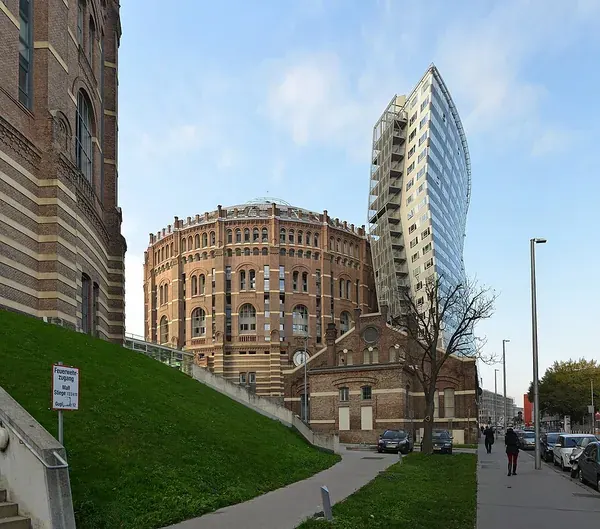
Gasometer B in Vienna, Austria, is a spectacular example of adaptive reuse architecture. Originally built as a massive industrial gas tank in the 19th century, the structure was transformed into a vibrant mixed-use residential complex and event center.
The project is visually defined by the addition of a striking "Shield"—a folded, leaning facade of glass and steel that stands apart from the historic brick shell.This structural extension serves a dual purpose: it expands the usable living space and acts as a buffer against street noise. Inside the cylinder, a central courtyard ensures natural light reaches the apartments and offices.
As a key component of the Gasometer City revitalization in the Simmering district, Gasometer B remains a benchmark for converting industrial heritage into modern, functional, and aesthetic urban living spaces.
Conclusion
In conclusion, COOP HIMMELB(L)AU has established itself as a beacon of innovation in the realm of architecture, consistently redefining the boundaries of what is possible in building design and construction. Their projects, characterized by a fearless embrace of new ideas and technologies, have not only transformed cityscapes but also the way we perceive and interact with our built environment.
COOP HIMMELB(L)AU’s work is more than just about creating buildings; it is about crafting experiences and narratives that resonate with contemporary societal and environmental values. Their emphasis on sustainable construction and digital integration points towards a future where architecture not only serves functional needs but also embodies a deeper engagement with our planet and its resources.
FAQs
1. What is COOP HIMMELB(L)AU known for in architecture?
COOP HIMMELB(L)AU is famous for creating bold, futuristic buildings that look really cool and different.
2. Can I see COOP HIMMELB(L)AU's work anywhere in the world?
Yes, you can see their amazing buildings in many countries—they design all over the globe!
3. Do COOP HIMMELB(L)AU architects design homes or just big buildings?
They mostly design large, public spaces like museums and concert halls rather than homes.
4. How does COOP HIMMELB(L)AU make their buildings stand out?
Their designs use sharp angles and unusual shapes to make something totally new and eye-catching.
5. Are there any awards that COOP HIMMELB(L)AU has won for their architecture?
Yes, they've won lots of prizes because so many people think their work is super creative and smart!

Rhino for Architects Course
Give your architectural skillset a major boost with the Rhino for Architects Course. Get over 60 hours of focused training tailored specifically for architects. Master commands and techniques to model, render, and animate architectural visualizations at the highest level. Click below for more information and watch your designs come alive!