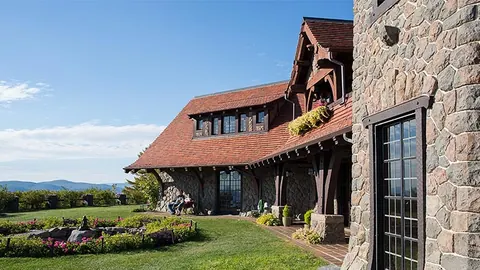
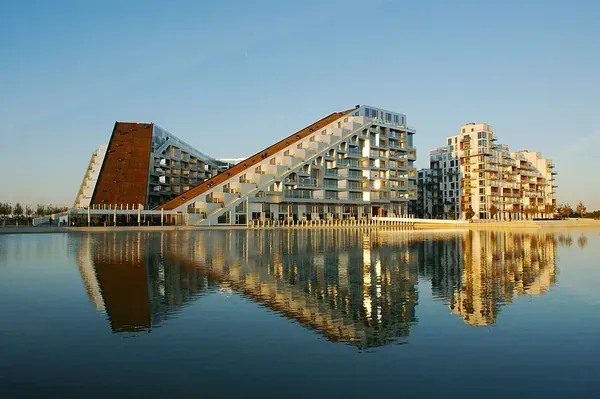
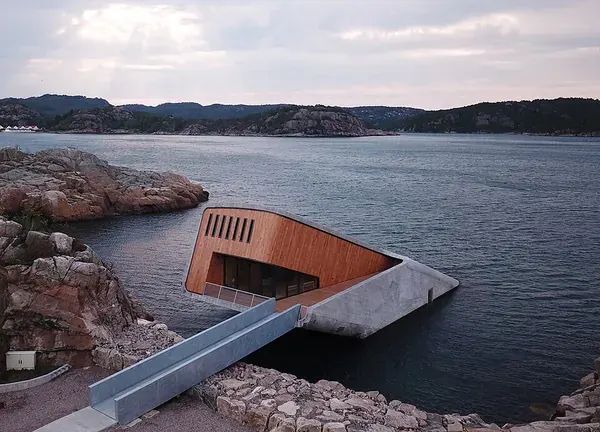
Ever questioned who’s the Lead behind the 20th and 21st century Architecture?Who are the innovators behind the emerging clean lines and simple design silhouettes?If you are an architecture lover, it is almost certain that you’ve gone through Instagram-favorites 8 House of Big architects, Tree Hotel Mirrorcubes of Tham & Videgård and Snøhetta’s Underwater restaurant.
Scandinavian Architecture - The Ultimate Guide
If you are an architecture lover, it is almost certain that you’ve gone through Instagram-favorites 8 House of Big architects, Tree Hotel Mirrorcubes of Tham & Videgård and Snøhetta’s Underwater restaurant.
If you are afurniture lover, it is almost unquestionable that you’ve heard about Ikea or purchased one of their products.
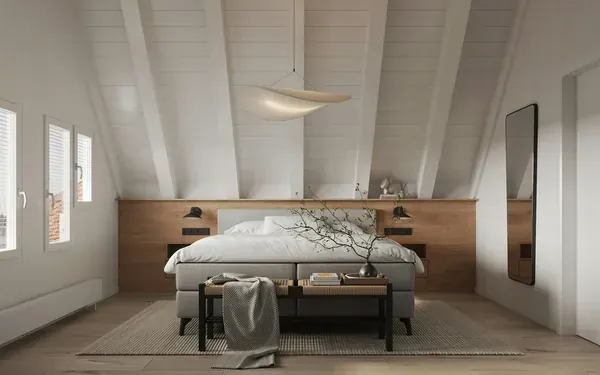
And if you’ve embraced when scrolling through social media simple wooden interior spaces and wished to have that kind of comfy space, there’s no doubt that you’ve been affected by Scandinavian Architecture.
Without knowing, you’ve actually discovered the pioneer style of the century.
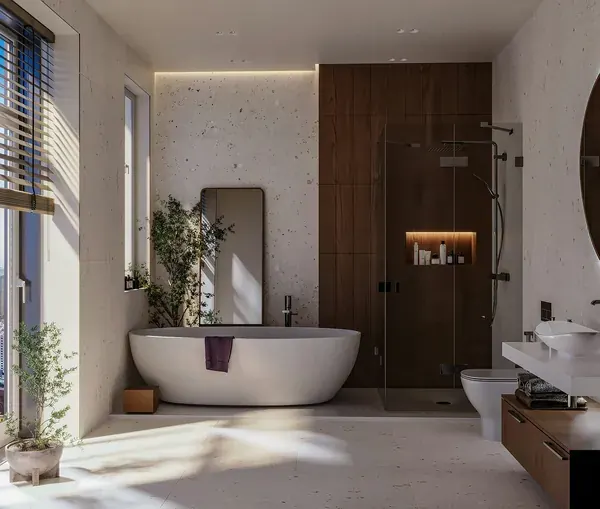
Before digging deeper into modern and traditional Scandinavian basics, let’s start by understanding the Term: Scandinavian Architecture and the countries behind this Scandinavian influence.
Revealing Scandinavian Countries
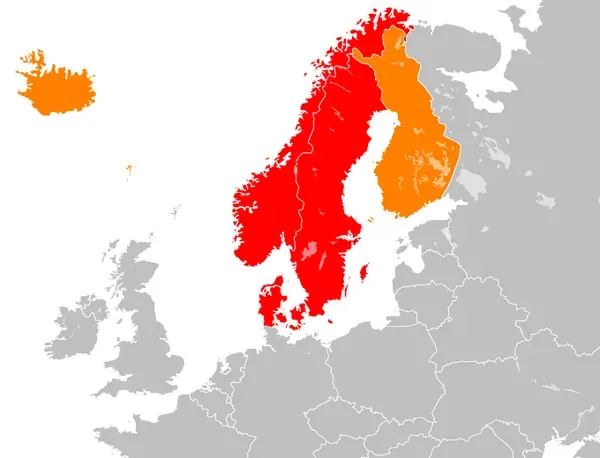
The term “Scandinavian Countries” usually covers the three kingdoms of Denmark, Norway and Sweden. Whereas on a broader scale, Nordic countries include Finland and Iceland in addition.
But, when the term “Scandinavian countries” is implemented regarding architecture, it is often used to refer to Nordic Countries’ architecture.
Knowing this slight difference, it’s time to discover the origin of Scandinavian architecture. If you are a fan of Viking series or Norse mythology movies, you are probably going to relate HARD to what’s coming next!
Traditional Scandinavian Architecture goes beyond the Vikings
Although people started settling in Scandinavia and calling it home soon after the Ice Age, traditional Scandinavian architecture is delimited by the Iron Age and the Viking Age.
This comes down to the fact that before the iron age, Scandinavians were nomads living in Teepees and after the Viking Age, they lost their architecture identity as they started importing European design style.
Major traditional buildings included boathouses, religious buildings and general buildings built by Scandinavians seafarers or farmers.
Although they may have different functions and sizes, all the buildings had often the same basic construction and materials including:
- Exterior walls made of wood, clay, wooden planks or wattle and daub and usually bowed
- Wooden columns supported the roof and divided the length into zones in some cases
- A stone contour at the bottom of the exterior walls to prevent from fire and protect the house
- Roofs were covered with either wood or turf
- The floors were made of wood, stone or earth depending on the function
Don’t get caught in the generals! We are all about the details here! Let’s Start!
Boating houses
Vikings designed boat houses following the boats dimensions (usually 25m long or more) to protect their Ships during winter. They executed them slightly back from the waterline and fixed them into the ground.
Well, I think if I had the most advanced ship of my time, I would certainly be taking that much care of it. If you're interested in Viking architecture specifically, you can check out this Viking Architecture Ultimate Guide.
Military buildings (Viking ring fortresses)
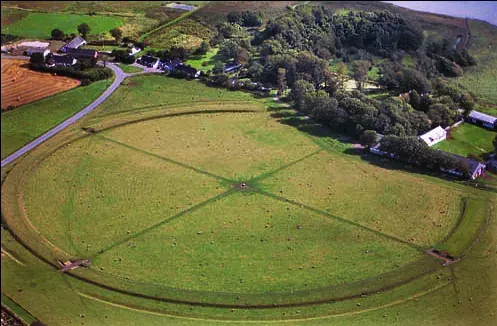
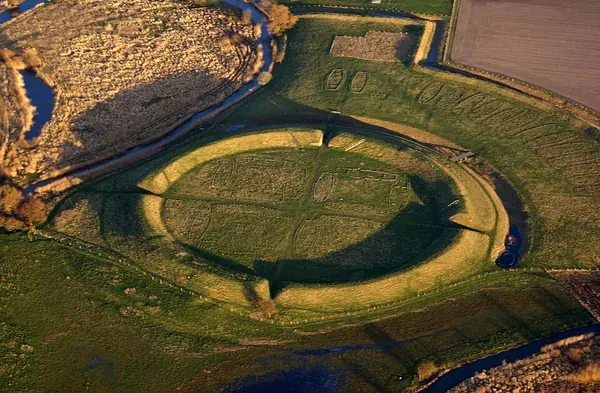
Until recent days, only six forts (called Trelleborg) were detected that date back to the reign of Harold Bluetooth of Denmark (died 986).
The word BLUETOOTH sounds familiar doesn’t it? Well, don’t be surprised you got it right! The Swedish Telecommunication company Ericsson were inspired by King Harold nicknamed Bluetooth after his dead tooth that looked blue to name their wireless tech.
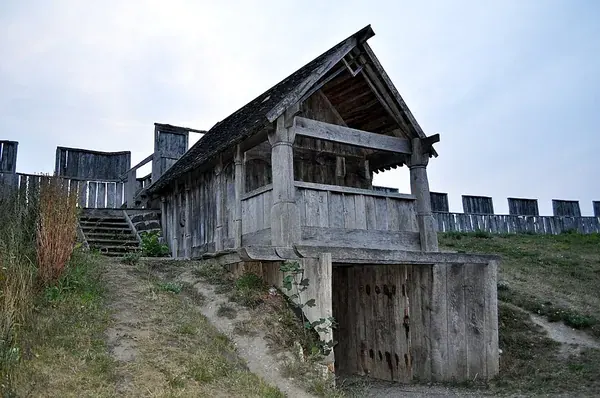
As for the fort’s geometry, they were all perfectly circular and encompassed with a rampart and four gates on opposite corners. The gates divided the inner courtyard into four areas which held the houses.
Religious Buildings
Religious buildings were called Ritual Houses and became Stave Churches after the Christening of Scandinavia. These houses went from simple to ornamented and multi-layered roofs structures.
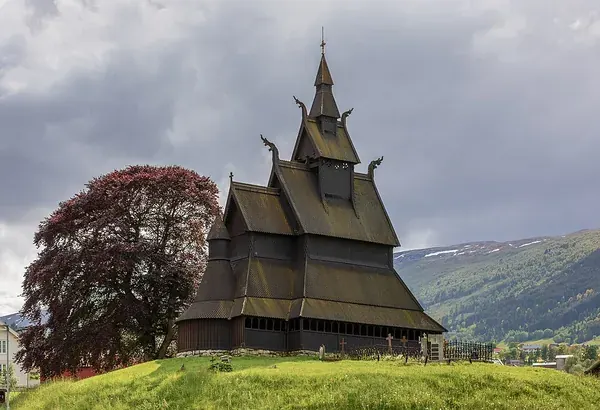
Ornamentations were on the outside of the buildings where rituals of slaughtered and burnt animal sacrifices took place. (I don’t think animal lovers are going to like this).
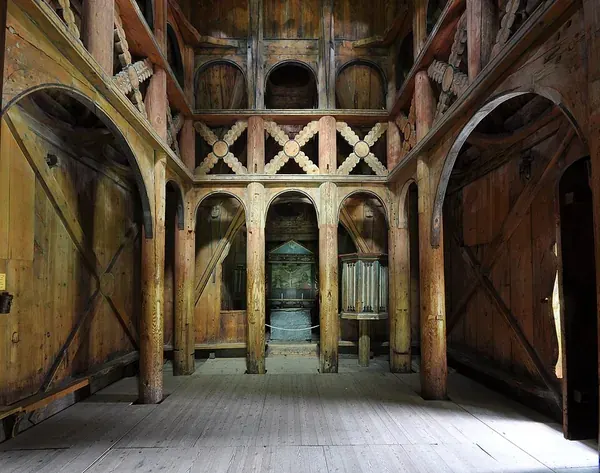
The Stave Churches can be distinguished from ritual houses with a tower or spine generally occupying the middle of the highest roof layer and Christian displays (Jesus, Cross, Disciples) in the interior instead of the weaponry of defeated enemy.
Countryside
These buildings were generally for farmers and had green roofs (planted dirt roofs) to preserve the heat inside.
The building was divided into 2 parts; a storage, sleeping and living area called “Inhus” and an animal farm called “Uthus” (for barns, fodder and tools).
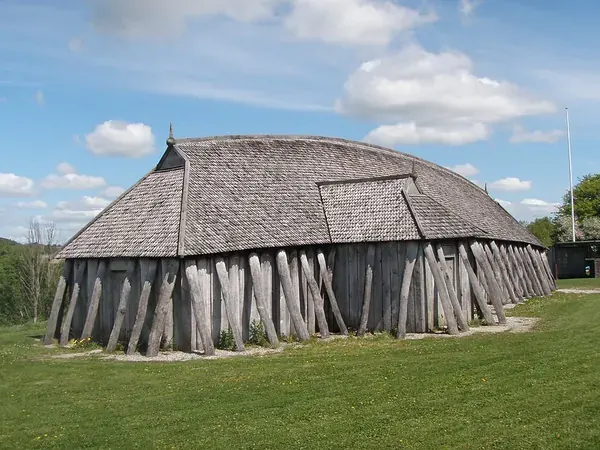
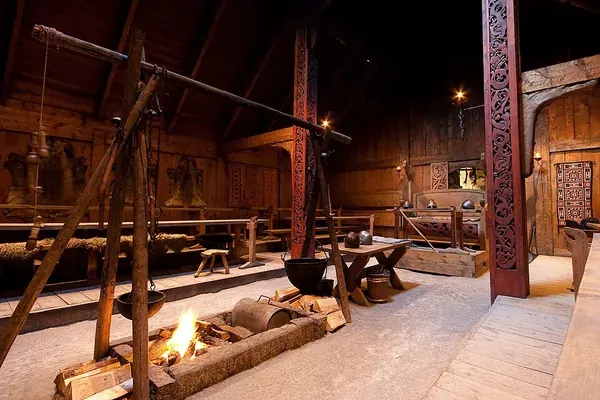
Viking Longhouse
As the name indicates, longhouseswere long with a typical length of 15 to 75 meters and a width of 5 to 7 meters. The longer the house was, the more the owner was considered wealthy and ofhigh social status (not a house for a lazy person that’s for sure).
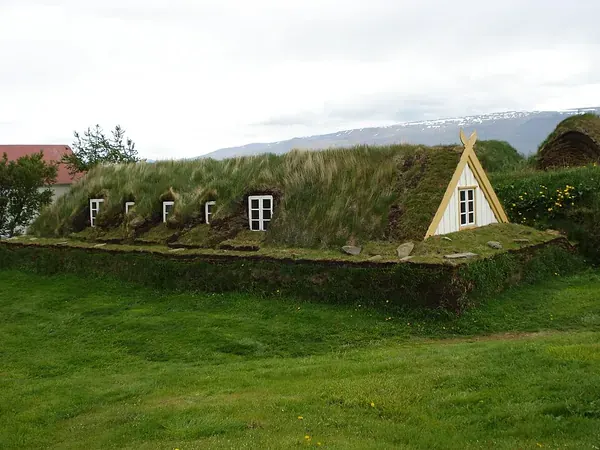
In areas that lacked timber, such as in Iceland, the wood was replaced with turf and sod, therefore homes were called Turf Houses.

Houses rarely had windows giving the cold weather thus in order to let the light in, they madegaps between the roof and walls or simply used the smoke vents modeled in the roof above the fire space for that purpose. The central space often contained the fire to heat the whole house.
To include everything like promised, The Sami people are a civilization that first settled Scandinavian countries around 100 AD and are now a bigger community around the world. They lived a full-scale nomadic life and herded reindeers for living (which inspired the movie Frozen 2 BTW).
Five Secrets of Scandinavian houses’ Elegance
I think that the beauty of Scandinavian styles lies within their simplicity. They knew how to beautifully understand their climate, adapt and translate nature’s disorder (mountains and fjords) into simplicity.
They prioritized their needs and innovatively incorporated them as design principles in the interior and exterior architecture. Those design principles can be summed up in the following five:
Light
Lack of daylightin the long winter season created the need for light enhancement features like skylights and translucent partitions to avoid depression. As such, light color palettes are preferred in interior spaces to reflect the light and illuminate the space.
Comfort
In long winters, Scandinavians spend a lot of time inside their homes which created a concept called “hygge”, alove of cozy spaces. Hygge tackles using natural and smooth textures (mainly wood), optimizing insulation for interior thermal comfort and creating diverse spaces like reading nooks to maximize interior activities.
Energy Efficiency
Scandinavian countries law grants energy efficient households withlow carbon emissions. Imagine the catastrophe if Nordic citizens ran out of fuel and had to face the cold weather!
Sleek Shapes
Scandinavian architects enjoy playing with geometry and shapes while maintaining clean lines in their designs and avoiding distracting elements.
Connection With Nature
Scandinavian architects shed light on merging their designs within the site and using local materials to promote their identity. They also like decorating interior spaces with plants.
The Five Warriors of Scandinavian Architecture
Scandinavian architecture is the fruit of all Nordic designers. Originality and innovation in their design field appeared around 100 years ago when Scandinavian countries had their independence and wanted to promote their individualism and identity.In that manner, Nordic designers stopped importing European design and started to mix their traditional elements with the available technology. In order to understand the 20th century Scandinavian architecture, take a look of how this style was maintained in each of the 5 Nordic countries. We need your FULL focus here! It’s worth the hustle! I promise!
Sweden
When breaking down the impact of the Nordic countries on the new style, Sweden is the first to introduce Scandinavian architecture of the 20th century with a mix of Neoclassicism and traditional local elements.
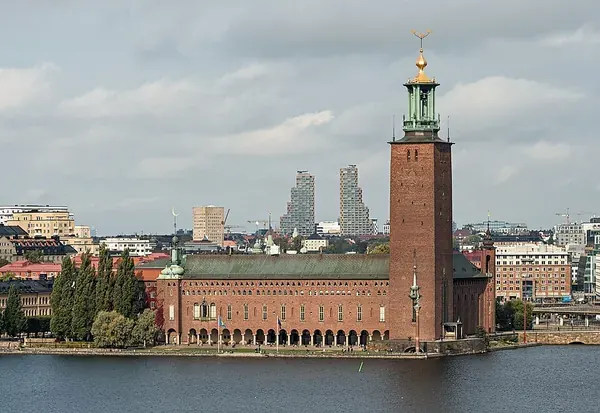
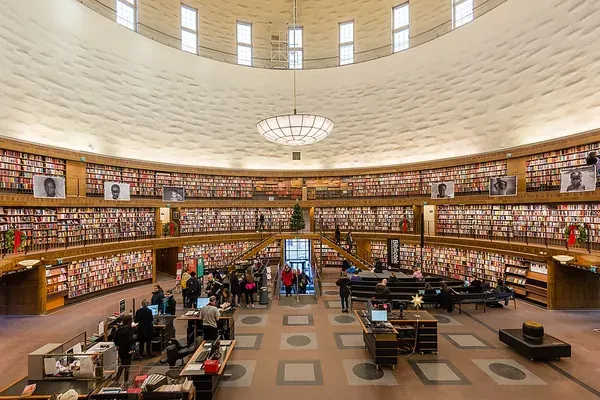
Swedish architects made their statement in Stockholm City Hall and Stockholm Public Library. The first, is still considered a country landmark having the old national symbol of Sweden (The Three Crowns) embellish its tower. The second, exhibits an iconic circular reading room.
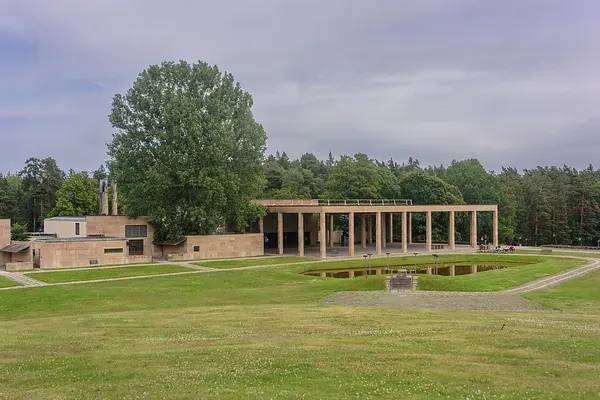
The Swedish Asplund, influenced by the Bauhaus and le Corbusier, introduced in 1930, following the Stockholm exhibition, functionalism, minimalism and humanitarianism into the Swedish architecture which set a new design base in Scandinavia and became a national style.
This style is demonstrated in Woodland Cemetery in 1940, a UNESCO World Heritage site.
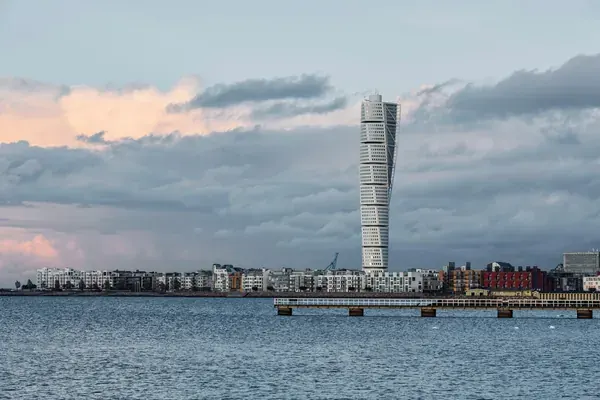
Other examples worth checking are Strömkajen Ferry Terminal in Stockholm, a creative contemporary structure made out of copper-zinc-alloy that seems to pop out its historic surrounding without being visually disturbing and the tourist attraction Turning Torso, inspired by a human looking behind him that introduces an organic feel to the Scandinavian design.
Finland
Throughout history, Finland was colonized on and off multiple times until it got its independence from the Russian Empire in the revolution of 1917. After its independence, local designers strived to prove themselves on international platforms and at the top came Alvar Alto and Eliel Saarinen.
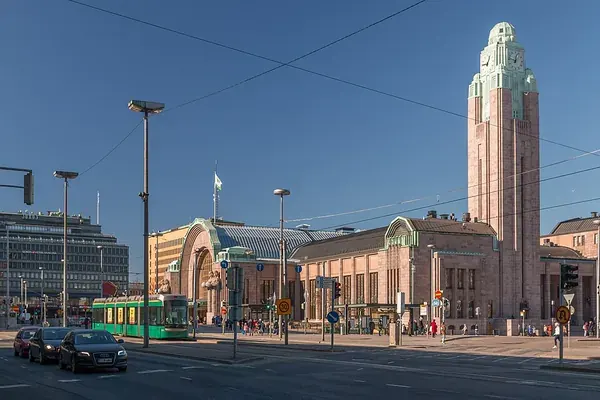
Saarinen fused traditional Finnish architecture with Art Nouveau and funded his Finnish style. Helsinki Central Railway Station, built 1909 to 1919 is Saarinen’s Finnish gem.
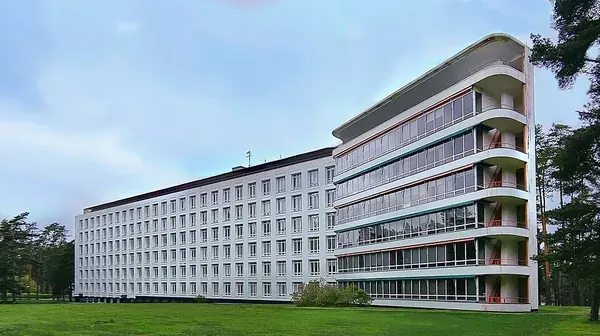
Alto later on, influenced by Asplund, smoothed functionality and proved his high space sensitivity in Paimio Sanatorium of 1933.In this project, the architect maximized the emergence of light and natural ventilation into the building to alleviate tuberculosis treatment and introduced in this project the bentwood Paimio chair.
The greatest Alto work was 1975’s Finlandia Hall, an iconic concert and conference center in Helsinki.
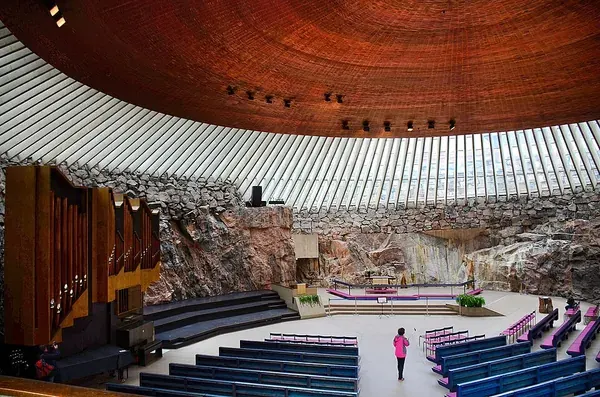
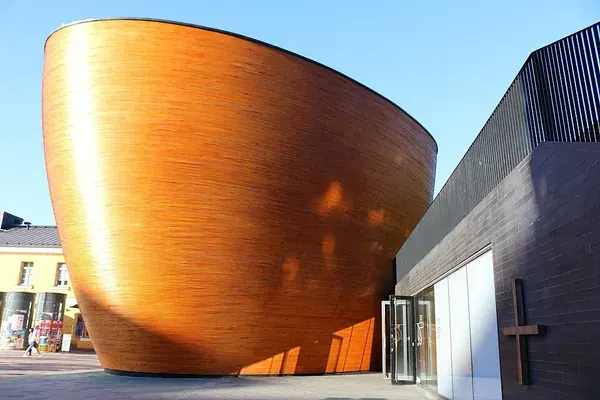
And finally, theKamppi Chapeldesigned by K2S Architects in 2012 and built in Helsinki showcases a transition between noise and serenity.
Denmark
Denmark started drawing its international frame in 1930 when danish architectArne Jacobsendesigned the functionalist beachfront in Copenhagen and the SAS Royal Hotel in 1960.
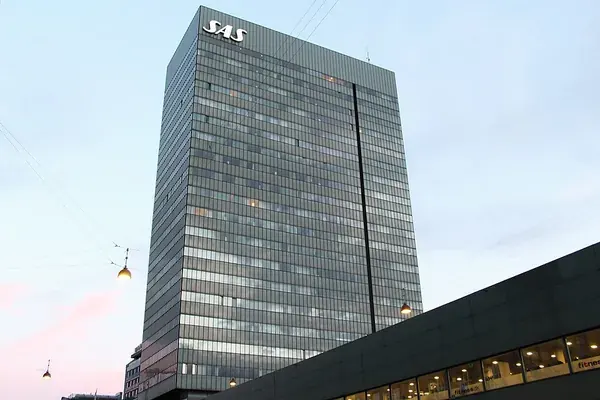
In the SAS Royal Hotel, the architect not only designed the building, he also designed the furniture called the Egg chair and the Swan Chair in addition to ashtrays.
The Sydney Opera House designed in 1973 by Danish architect Jorn Utzon is a testament of how Danish architecture started breaking frontiers and spreading all over the world.
The Opera house design stands as an homage to the waves of Austrian Pacific Coast.

At the forefront of Danish international architecture firms is Bjarke Ingels Group known for their focus on solving problems of urbanization and creating livable, sustainable housing and office solutions like 8 House.
Norway
As it got its independence from Sweden in 1905, Norway had a patriotic desire to prove itself and establish an architectural identity that would distinguish it from its surrounding.Norway succeeded in creating a unique modern style using the aesthetic of its Norwegian wood and many architects followed this style to contribute to the national portfolio.
One of the first Norwegian projects is Oslo City Hall designed in 1930 by Arnstein Arneberg and Magnus Poulsson and completed until 1950. The project gently mixes functionalism and Norwegian-themed applied art.
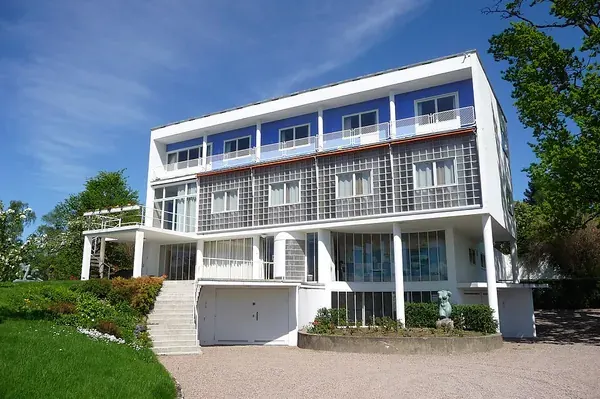
Villa Stenersen of 1939 is another notable work of 20th century Norwegian architecture. This Arne Korsmo work, praised for its modern use of glass and concrete, became later on the prime minister’s residence.
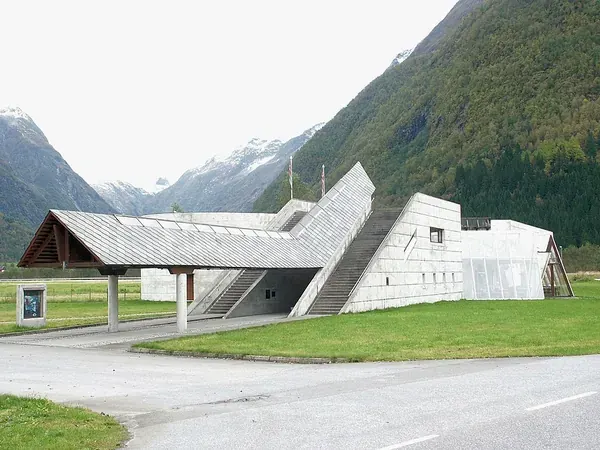
One of the top Norwegian projects is also The Glacier Museum by Sverre Fehn, winner of the Pritzker Prize in 1997. Having a delicate site located between the end of a fjord and the entrance to a national park, the architect knew how to balance between contemporary forms and the natural context.
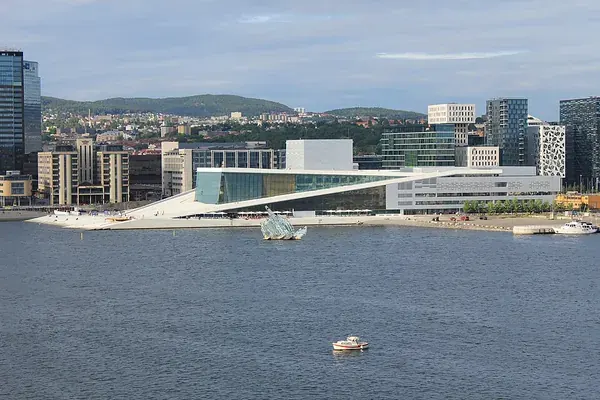
The international Norwegian firm Snøhetta raised even further the Norwegian architectural style. Its Oslo Opera house designed in 2008 incorporates board ramps that take tourists on a journey to the roof. They get to enjoy the contrast between the exterior glass walls, the curved interior wood-lined walls and the natural view.
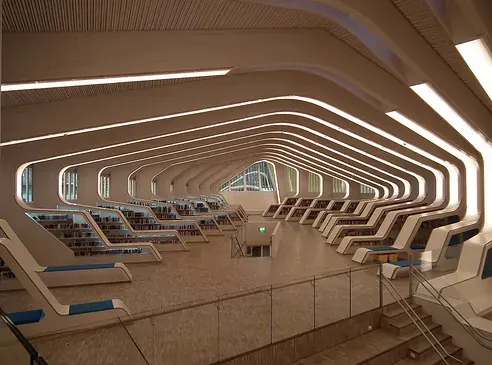
The wooden national style is clearly celebrated in the main hall of Helen & Hard’s Vennesla Library and Cultural Centre of 2011.
Iceland
Iceland got its independence from Denmark in 1944 thus did not have its own qualified designers and architects until the 20th century. The Icelandic architecture philosophy came as an homage of its nature especially thebasalt rock.
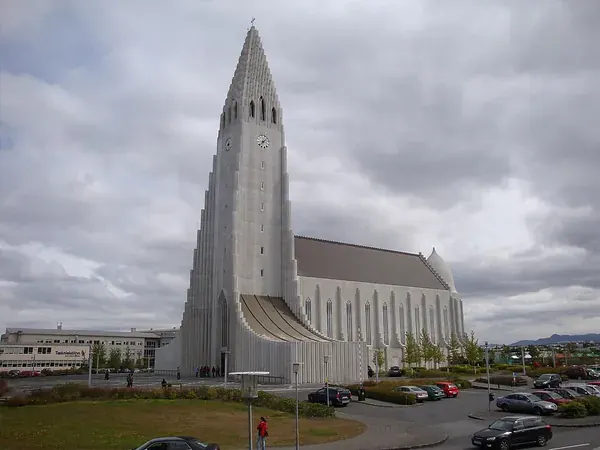
Guðjón Samúelsson is the first to define Iceland’s national style. He built both National Theater completed in 1950 and Hallgrímskirkja, the country’s largest church in 1980. In both designs, he innovatively used concrete as a base material to imitate the basalt lava rock cliff formations.
The most notable Icelandic design and perhaps Nordic design is the 2011 Harpa Concert and Conference Hall by Henning Larsen Architects of Copenhagen and Danish-Icelandic artist Ólafur Elíasson. The structure uniquely combines colored glass of lava formation making it the best representation ever made from a natural inspiration.
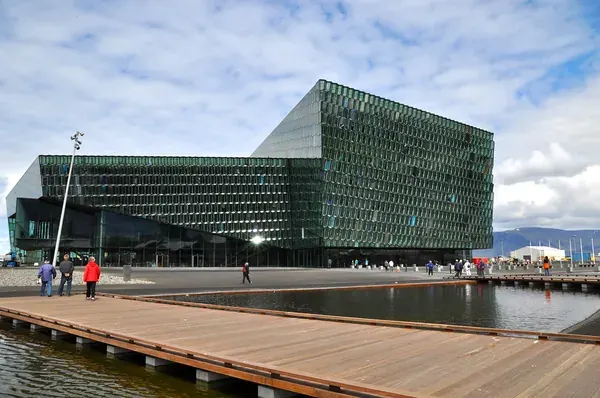
Amazing isn’t it!Not Only the Scandinavians designed beautifully, they also designed wisely. And Here’s why.
Scandinavian architecture goes GREEN
Scandinavian architecture shows deep care for sustainable and green designs and responds to urgent environmental challenges by incorporating innovative and creative solutions.
Such examples are Snøhetta’s Powerhouse Drøbak Montessori Secondary School in Norway, a project that generates more energy than what it consumes and the 2019’s Copenhagen Amager Bakke, a power plant designed by BIGthat converts waste into clean energy and helps reduce the city’s carbon emissions.
After all, Scandinavian firms seem to be the pioneers of the 20th and 21st century architectural stylewith their deep sensation for functionality, aesthetic and sustainability. This architecture style that emerged in the 20th century respects human needs and human form with clean lines and ecological buildings. Scandinavian architects seem to infuse their designs with their Nordic natural ice floes, mountain peaks, snow-covered forests, looming tors, in the most innovative way that doing it- Scandinavian way is the new thing!

Rhino for Architects Course
Give your architectural skillset a major boost with the Rhino for Architects Course. Get over 60 hours of focused training tailored specifically for architects. Master commands and techniques to model, render, and animate architectural visualizations at the highest level. Click below for more information and watch your designs come alive!