The Kisefos Museum designed by Bjarke Ingels Group (BIG) is an architectural marvel located in Norway. The unique and intricate design required complex modeling using Rhino and Grasshopper. Recently opened, the museum has already become an iconic destination.
The Concept Behind Kisefos Museum Design
Bjarke Ingels describes how the location and concept evolved for the Kisefos Museum design:
“In our search for a site, we came further and further away from the old mill. Because we somehow didn't want to compete with history and heritage, and ultimately we found that and we kept going closer and closer to the water because from the water you had a more incredible view of the river and of the mill, and eventually it just became clear to us that by spanning the river we could transform the two sides into one continuous journey and it just felt like everything was. It's very simple.”
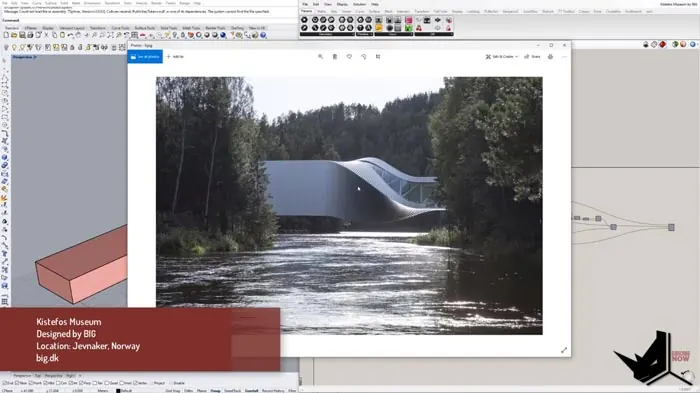
From there, the project became a merging of opposites, combining the mountain and forest surroundings, joining the two sides of the river, the vertical and horizontal. Altogether, the final result resembles a sculpture.
The gestural form of the museum was generated by rotating and twisting rectangular forms to create a flowing, sculptural shape. The museum consists of three main sections - two horizontal galleries joined by a twisted vertical section spanning the river.
Modeling in Rhino and Grasshopper
To model the complex organic form of the Kisefos Museum design in Rhino, we created a Grasshopper definition.
The first step was generating a rectangular surface and then using the Construct Brep component to select specific faces. These faces were then used to create divisions across the surface using the Butterfly Tween Through Surfaces component.
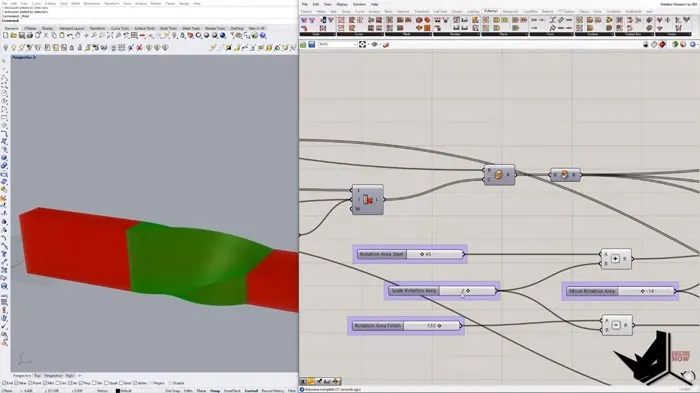
The surface was divided into three sections - two horizontal and one vertical twisted section. Mathematical formulas were created in Grasshopper to control the number of divisions and enable moving and scaling the vertical section.
Each section was then rotated incrementally using the Rotation component in Grasshopper to achieve the twisting organic form. The three sections were then merged to create the final form.
Parametric Modeling Benefits
Using Grasshopper for Rhino allowed us to create a parametric model where the design can be easily modified by changing the input numbers and sliders. This enables iterating and optimizing the design efficiently.
The parametric definition also enabled modeling the complex geometry accurately which would have been extremely difficult to do manually.
Exploring Architectural Modeling
For architects and designers interested in learning parametric modeling, Grasshopper training programs like Rhino and Grasshopper courses help build expertise.
The unique design of the Kisefos Museum exemplifies how computational tools like Grasshopper can push the boundaries of architecture. Parametric modeling unlocks new creative possibilities for organic, sculptural, and interactive designs.
Grasshopper Complete Course
Give your architectural skills a boost with the Grasshopper Complete Course. Get over 50 hours of comprehensive Grasshopper training tailored for architects. Learn to generate and iterate designs faster. Click below for more information and streamline your workflows!