The Barcelona Pavilion, designed by famous modernist architect Ludwig Mies van der Rohe, is one of the most iconic buildings in architectural history. In this comprehensive tutorial on Modeling Barcelona Pavilion in Rhino, we will learn step-by-step how to accurately capture the pavilion’s distinctive geometric shapes and glass walls using Rhino's powerful modeling tools.
Overview of the Barcelona Pavilion
The Barcelona Pavilion was the German national pavilion for the 1929 International Exposition in Barcelona, Spain. The pavilion did not actually exhibit anything - it was designed by Mies purely to showcase modern architectural techniques and materials.
Featuring a minimalist design with smooth surfaces and an open floor plan, the Barcelona Pavilion became a landmark of modern architecture. It incorporates innovative uses of glass, steel, and stone. The pavilion is considered a masterpiece of Mies' signature "less is more" approach.
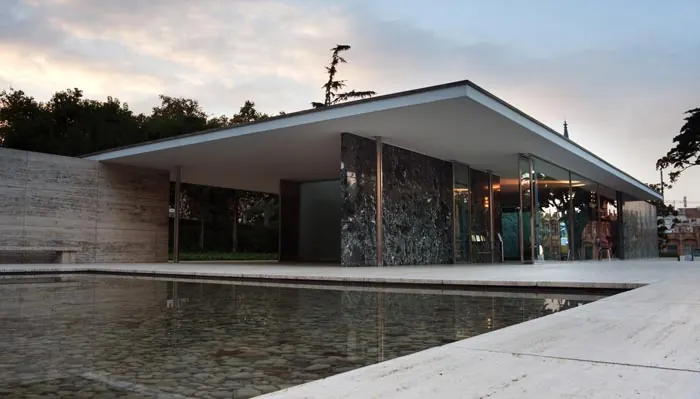
While the original pavilion was demolished in 1930, it was reconstructed in the 1980s using Mies' original plans. Modeling Barcelona Pavilion in Rhino allows us to study and appreciate its brilliant geometric forms.
Starting the Rhino Model
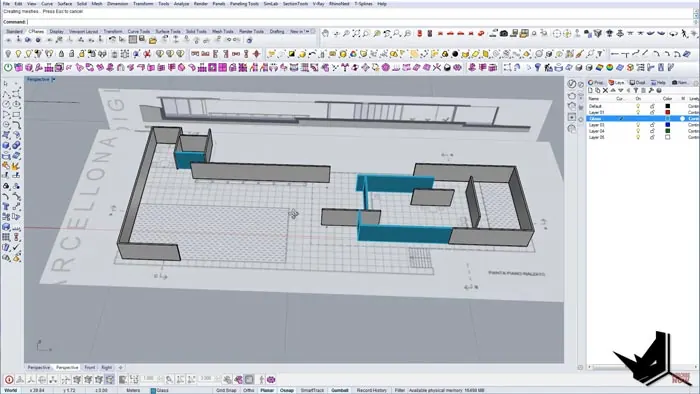
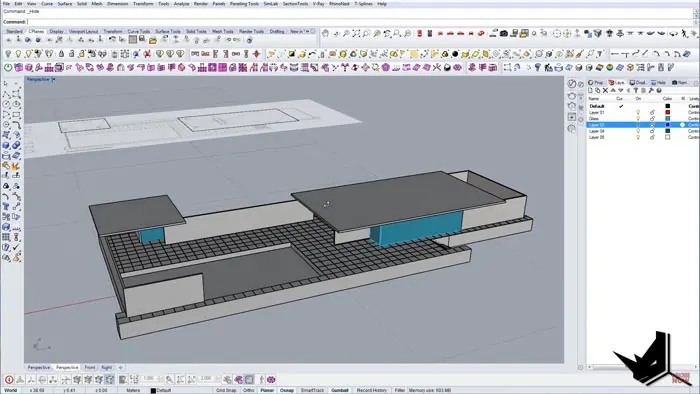
To begin modeling the Barcelona Pavilion in Rhino, we will import the floor plan drawing and use it as a template to build upon. After splitting the drawing into sections, we can start tracing the outline of the walls on top of the drawings.
Using Rhino's Rectangle and Scale commands, we can quickly draw each wall section based on the lines from the floor plan. Then we will use Boolean operators to delete the excess lines and keep just the wall outlines.
Changing the wall layers to different colors helps visualize which walls are meant to be glass versus stone. We can also establish the height of the walls by importing a section drawing, rotating it vertically, and using it as a height reference.
Adding the Remaining Structures
With the key walls in place, we can rapidly fill in the rest of the pavilion's structures. The glass divider walls, pool, roof, and stairs are all easy to construct through Rhino's intuitive modeling tools.
For example, the angled roof is made by copying lines from the floor plan and then using commands like Extrude, Sweep, and Scale to generate the roof surface. The stairs are formed by dividing edges into segments and extruding them.
For the floor, we can create a grid to represent the divider seams on the stone surface seen in the original pavilion. By offsetting and subtracting this grid, the distinctive floor pattern emerges.
Completing the Modeling of Barcelona Pavilion
In a short time, we have completed the modeling of the Barcelona Pavilion, ready for rendering and visualization. This tutorial demonstrates efficient techniques for modeling complex architectures purely through straightforward geometries in Rhino.With a bit more detailing added, this Rhino model could be used for virtual reality walkthroughs, animations, 3D printing, and many other applications.
Studying such an influential building through modeling it yourself gives insights into the ingenious methods of modernist architects like Mies van der Rohe.Want to try modeling the legendary Barcelona Pavilion yourself in Rhino? Get started by downloading the project files and follow along with the steps outlined here for modeling the Barcelona Pavilion.
Rhino for Architects Course
Give your architectural skillset a major boost with the Rhino for Architects Course. Get over 60 hours of focused training tailored specifically for architects. Master commands and techniques to model, render, and animate architectural visualizations at the highest level. Click below for more information and watch your designs come alive!