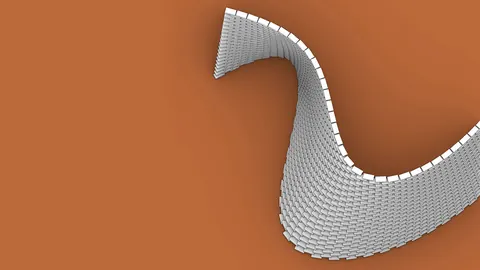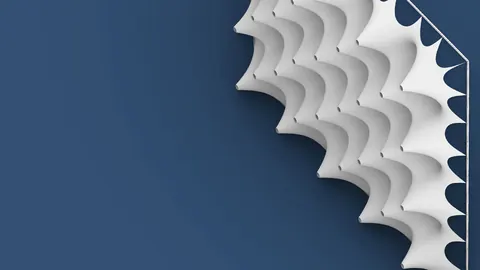
Facade design is an integral part of architecture. It serves as the face of a building and makes the first impression on viewers. Many contemporary architects use complex geometries and forms to create unique and memorable facades. One such architecture firm known for its innovative facade designs is MVRDV.
In this blog post, we will learn how to recreate a complex MVRDV facade design in Grasshopper. We will use parametric modeling techniques to generate a brick pattern facade with a dissolving effect like the MVRDV's Crystal House project.
Overview of the Crystal House MVRDV Facade Design
The Crystal House designed by MVRDV combines traditional terracotta bricks with solid glass bricks. The transition between the two materials creates a unique dissolving effect.
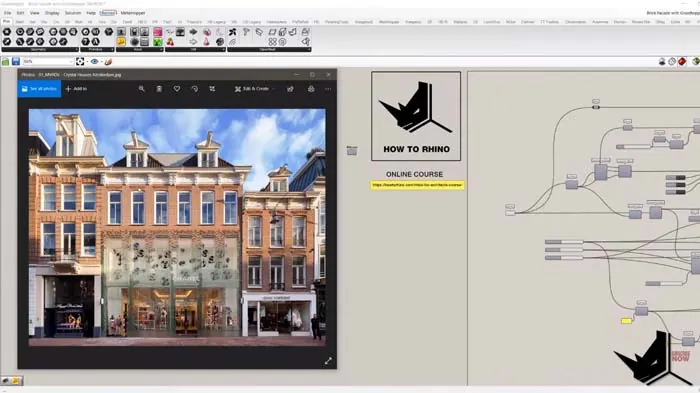
The bricks are arranged in a staggered pattern. There are two types of bricks used - a standard small brick and a larger double brick. The double bricks are placed on every alternate row.
The parametric design allows the creation of the dissolving pattern by controlling the position and density of the glass and terracotta bricks. Let's see how we can recreate this effect using Grasshopper.
Creating the Brick Pattern in Grasshopper
The first step is to set up a surface to represent the facade. We can import a predefined surface shape or create one from scratch.
Next, we need to generate horizontal contour lines along the surface spaced at the brick height - 65 mm in this case. The Contour component in Grasshopper can be used for this.
We split the contour lines into two sets - one for the double bricks and one for the standard bricks. The points where the bricks will be placed are created along each contour line using the Divide Curve component.
For the double brick rows, the division length is 210 mm (the length of one brick). For the smaller rows, it is 105 mm (half the brick length).
The points are then used to generate brick geometry using the Brick component. The proper orientation of the bricks is ensured by constructing a plane parallel to the surface.
Finally, the brick geometry is trimmed against the surface edge to create the desired MVRDV facade design.
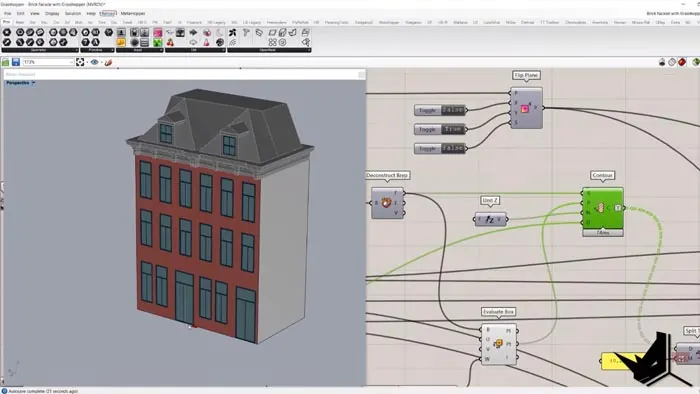
Creating the Dissolving Effect
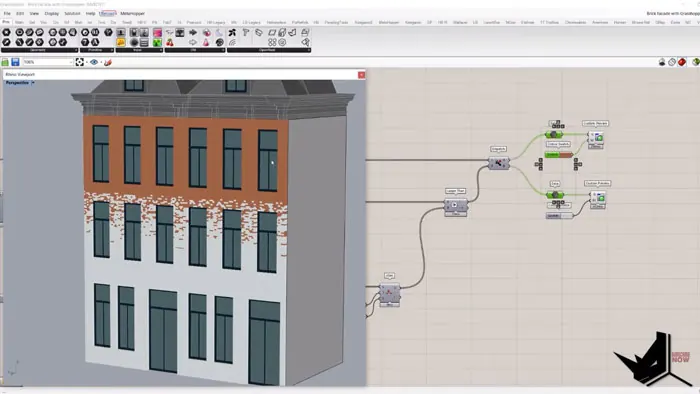
The dissolving pattern is generated by controlling the visibility of the brick and glass panels. The logic involves comparing the Z coordinate of each brick's center point to a randomly generated value.
The center points of the bricks are extracted and the Z coordinate is remapped to a 0-1 range. An equal number of random values between 0.5 and 0.7 are generated.
If the brick's Z value is less than the random value, it is assigned to the glass material. Otherwise, it is assigned to the brick material. This probability-based approach creates the dissolving pattern.
The effect can be controlled by changing the random number range and distribution. The higher the random values, the more diluted the brick pattern becomes.
Summary of MVRDV Facade Design
This tutorial demonstrated how a complex MVRDV facade design like MVRDV's Crystal House can be recreated in Grasshopper using parametric modeling.
The key steps are:
- Generating the underlying surface
- Creating a staggered brick pattern
- Splitting rows for standard and double bricks
- Orienting the bricks properly
- Trimming against the surface edge
- Controlling visibility based on probability
Grasshopper provides extensive control over the facade composition. Parameters like brick size, spacing, density, orientation, and more can be changed to create countless iterations.
This makes Grasshopper an invaluable tool for architects looking to design distinctive MVRDV facade designs like MVRDV. With practice, you too can start generating innovative facade designs!

Grasshopper Complete Course
Give your architectural skills a boost with the Grasshopper Complete Course. Get over 50 hours of comprehensive Grasshopper training tailored for architects. Learn to generate and iterate designs faster. Click below for more information and streamline your workflows!