
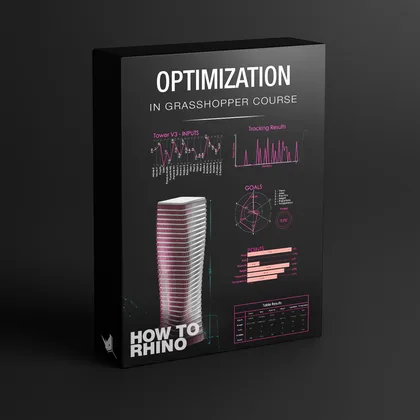
You've built a powerful parametric model... but how do you know you've found the best design?
You've spent days, maybe even weeks, crafting the perfect parametric definition. You have sliders that control every aspect of your design, creating a universe of possibilities.
But this brings a new, paralyzing problem: with millions of potential variations, how do you choose the "best" one? Do you rely on your intuition? Do you manually tweak sliders for hours, hoping to stumble upon a better result? How do you defend your final choice to a client or stakeholder when it's based on a "gut feeling" rather than hard evidence?
This is the ceiling of traditional parametric design, the point where creative freedom becomes a frustrating exercise in guesswork.
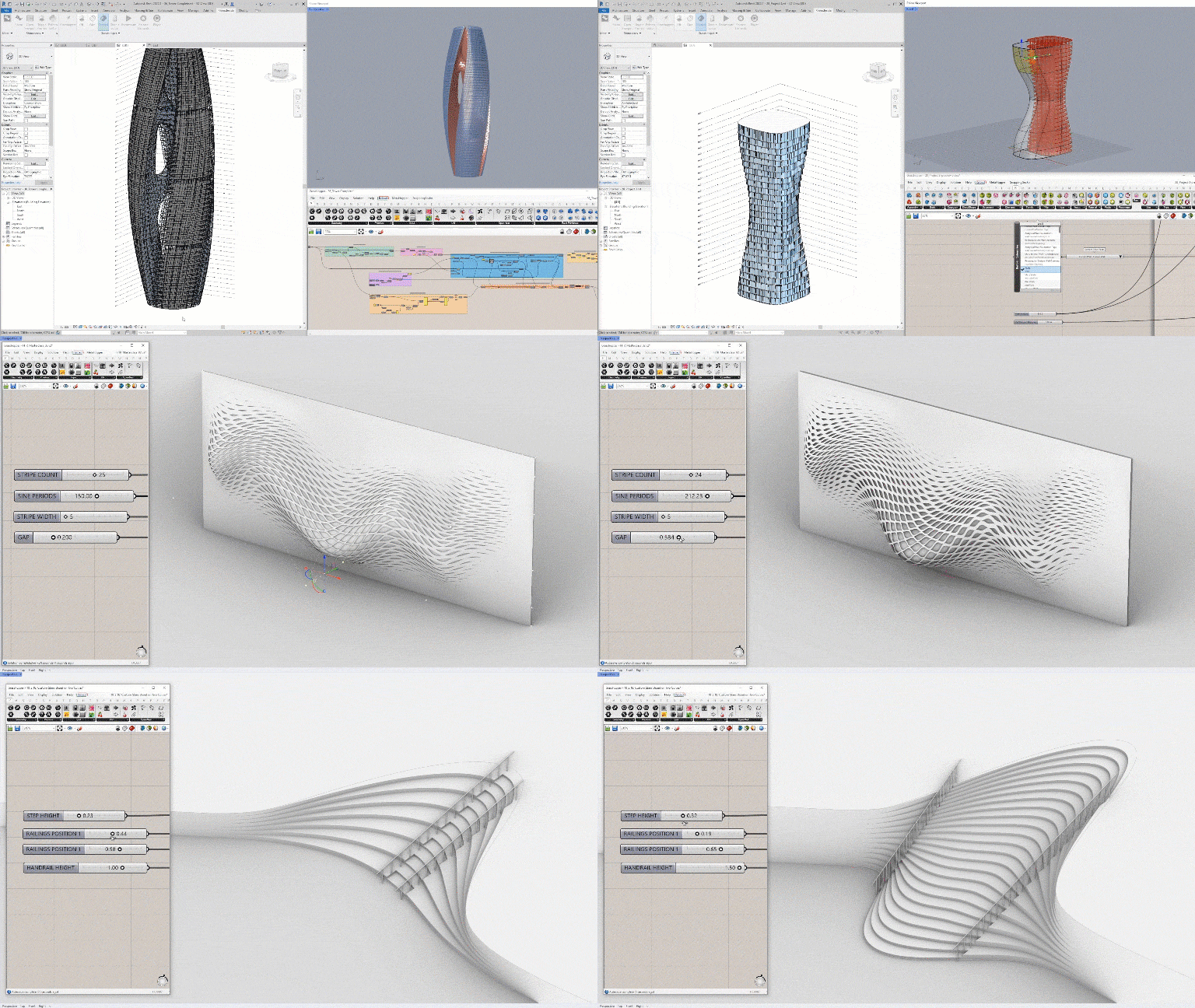
What if you could analyze thousands of design variations and let the data show you the optimal path forward?
Imagine this: Instead of manually searching for a better solution, you simply define your goals, minimize material usage, maximize floor area, reduce solar gain, or all of the above. Then, you unleash a powerful algorithm to explore the entire design space for you.
It generates and tests thousands of options, learning and evolving with each generation, systematically homing in on the designs that perform the best according to your specific criteria.
Imagine confidently walking into a client meeting, presenting not just one beautiful design, but the optimal design, backed by a clear data trail that proves its superiority.
This isn't a futuristic fantasy. This is the power of computational optimization.
The Answer: Algorithmic Design Confidence
At its core, optimization is simply a method for finding the best possible design solution. And for parametric design in Grasshopper, the most powerful tool for this is Genetic Algorithms.
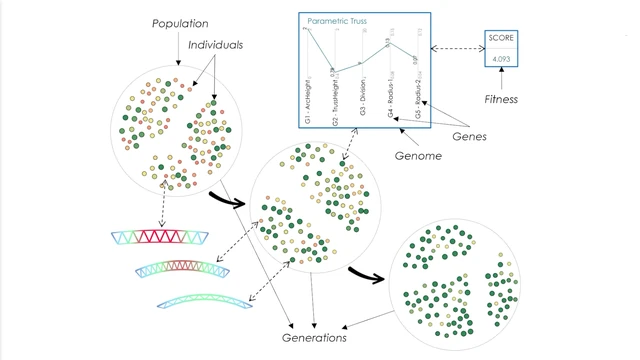
Inspired by Natural Selection
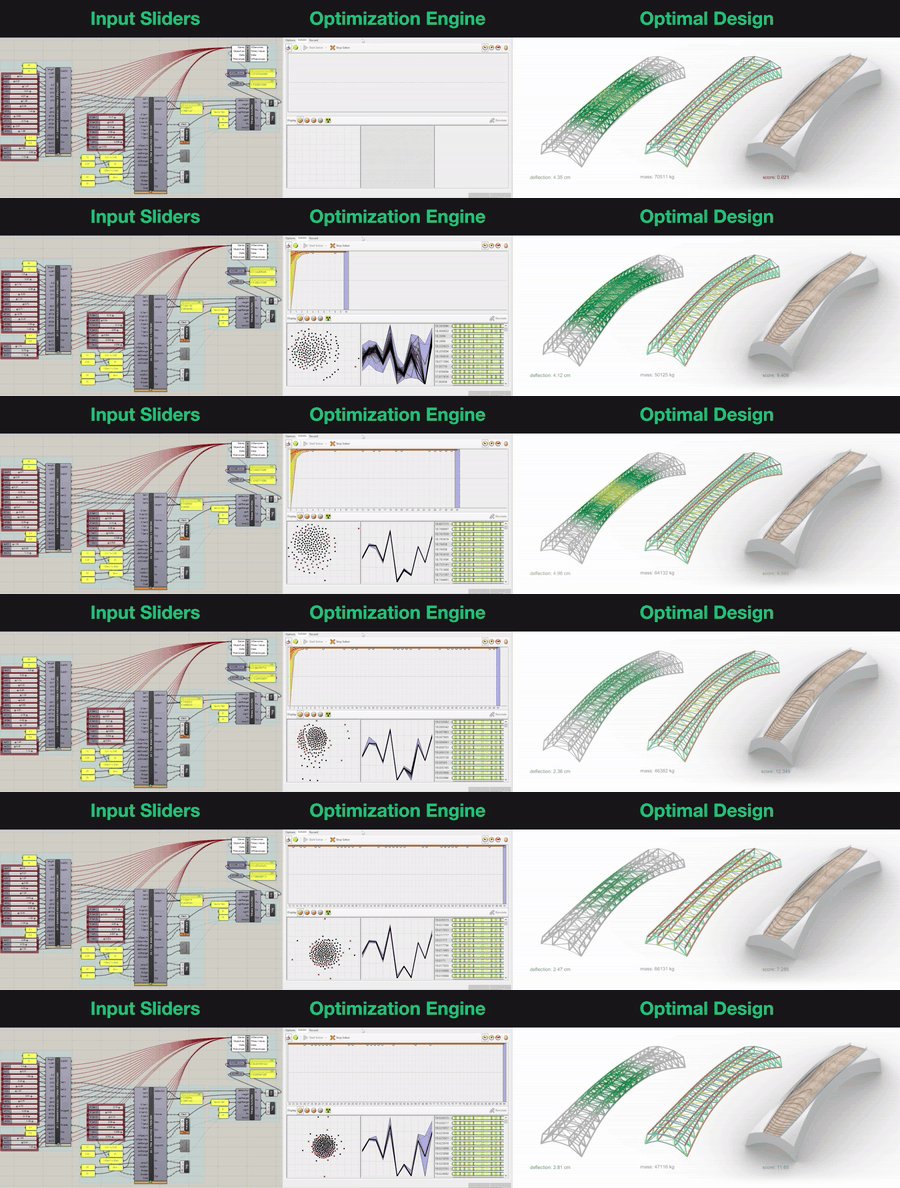
Genetic Algorithms take your parametric model, generate a population of design "individuals," and test their "fitness."
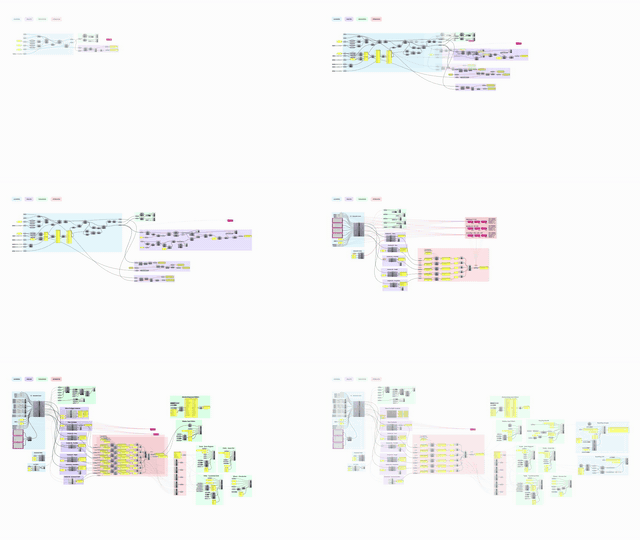
Evolution Towards Optimality
The best-performing designs "survive" and "reproduce," passing their traits to the next generation.
Your New Role
Transform from a manual "slider-tweaker" to a visionary "goal-setter." You define what "better" means, and the algorithm finds it.
Optimization in Grasshopper Course
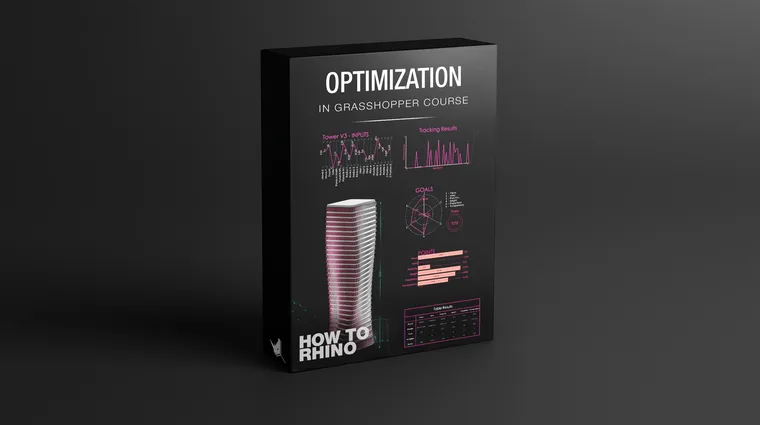
With our Optimization in Grasshopper Course, you'll learn...
- The core theory of Genetic Algorithms and how to apply them in Grasshopper
- How to build single-objective and multi-objective optimization workflows from scratch
- Advanced data visualization and export using our exclusive Dolphin plugin
- How to use popular plugins like Ladybug, Kangaroo, Karamba for custom analysis
- How to explore alternative engines like Wallacei, Octopus, and Biomorpher
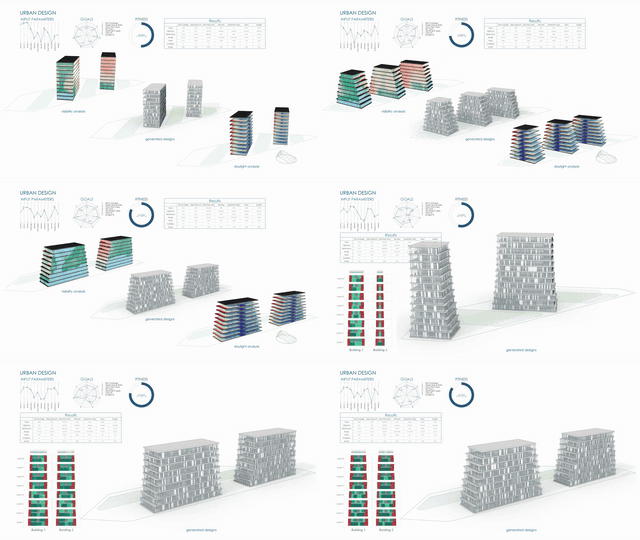
- Practical skills through real-world architectural projects: high-rise buildings, pavilions, and urban design
- Lifetime Access
- Immediate Start
- Multiple Optimization Engines
- 37+ hours of video material
- Exclusive 'Dolphin' Plugin
- 4 Core Architectural Projects
- Resources and PDF Guides
- Project & Homework Files
- Future Updates
Optimization in Grasshopper Course is designed to take you from the foundational theory to advanced, real-world application with a logical, project-based approach. The course is led by Ognjen Graovac, an architect and computational designer who founded Algorithmic Architecture and has applied his advanced Grasshopper skills to some of the world's most iconic projects, including the Madison Square Garden Sphere in Las Vegas and the Kuwait International Airport.




In the beginning, we'll start with a quick introduction to Genetic Algorithms, explaining the theory and the algorithms in the background. Also, we will go through basic and more advanced Grasshopper skills like data structures, transformations, clusters, parallel computing and much more. Then, we'll move straight into practical examples related to high-rise buildings, urban design, pavilions and bridges. Step by step, you'll learn how to handle single-objective and multi-objective optimization, visualize numeric data, use popular plugins for different analysis methods and explore various optimization engines.
Aside from video tutorials and project files, you will also gain special access to the exclusive Grasshopper plugin for data visualization and exporting files: "Dolphin".
What's inside?
In this chapter we will introduce you to the Optimization in Grasshopper Course. We will talk about what to expect from this course, who is it for, and what you'll learn. Also, you will get all the necessary information on software requirements and instructions on how to install the plugins for Grasshopper.
In this chapter you'll learn:
- The complete course structure and what to expect in each chapter
- How to install all the necessary software and Grasshopper plugins
- How optimization can be applied in your work to improve design quality and efficiency
Explore the core theory of optimization before applying it in Grasshopper. Learn about Genetic Algorithms, how to control population and generations, define genes, and most importantly, create a powerful fitness function to guide your designs. You will master the logic, strategy, and mindset necessary for running optimizations using Galapagos, Grasshopper's built-in solver.
In this chapter you'll learn:
- Understand the core theory of Genetic Algorithms and how they find optimal solutions
- How to define a "fitness function" to guide the algorithm toward your specific goals
- The fundamentals of using Galapagos, Grasshopper's native optimization engine
- The essential problem-solving mindset required for effective optimization
This chapter is designed to refresh and strengthen your Grasshopper knowledge, ensuring you are fully prepared for the optimization challenges ahead. We will revisit fundamentals, computational geometry, and efficient workflows to build your confidence and refine your parametric skills.
In this chapter you'll learn:
- How to master Grasshopper fundamentals, including data types and structures
- Core concepts of computational geometry with points, curves, surfaces, and meshes
- Advanced techniques for speeding up your definitions and improving performance
- How to build reliable and well-organized parametric models
Move from theory to practice by developing Grasshopper algorithms to solve real-world architectural challenges. Build complex definitions from scratch for a high-rise building and a pavilion, focusing on achieving one specific goal at a time.
In this chapter you'll learn:
- How to build a complete optimization workflow from an empty canvas
- Practical techniques for optimizing architectural models for a single, clear objective
- How to properly structure and organize your Grasshopper definitions from the start
- Creative problem-solving skills through hands-on homework assignments
Tackle real-world design problems by balancing multiple, often competing, objectives. Upgrade the high-rise model and create a new urban design project, learning to prioritize goals, use clusters to keep models organized, and interpret complex optimization results.
In this chapter you'll learn:
- How to create a fitness function that balances multiple, competing design goals
- Strategies for prioritizing objectives to refine and guide optimization outcomes
- How to use clusters to keep large and complex parametric models well-organized
- Analytical skills to interpret the results of multi-objective optimizations
Learn the most critical part of the workflow: communicating your results. Use our exclusive Dolphin plugin to visualize inputs, color analysis results, and automatically export rendered images and numerical data for presentations.
In this chapter you'll learn:
- How to translate raw numeric data into compelling visuals that communicate your design's performance
- Advanced mesh visualization techniques using vertex colors for fast feedback
- How to automatically export large datasets, including image sequences and Excel files
- How to master our exclusive "Dolphin" plugin to streamline your workflow
Integrate popular plugins to dramatically improve the precision of your analyses. Use Ladybug for sun/visibility, Kangaroo for form-finding, and Karamba/Millipede for structural analysis.
In this chapter you'll learn:
- How to integrate specialized plugins like Ladybug, Karamba, Kangaroo, and Lunchbox
- How to run advanced sunlight, visibility, and structural analysis on your designs
- Techniques for balancing time efficiency and precision in complex simulations
- How to use the data from custom analyses to drive your optimizations
Explore popular alternative optimization engines like Wallacei, Octopus, and Biomorpher. Understand their unique workflows, user interfaces, and advanced controls to find the tool that best fits your style.
In this chapter you'll learn:
- The unique features and workflows of engines like Wallacei, Octopus, and Biomorpher
- How to gain more control over key optimization concepts like the selection process
- How to use advanced user interfaces to better explore the fitness landscape
- How to choose the right optimization tool for your specific design problem
Bring everything together in a final review of key concepts, strategies, and best practices. Solidify your understanding of what defines an efficient model and a strong evaluation process, enhancing your confidence in data-driven design.
In this chapter you'll learn:
- A summary of key strategies and best practices for professional optimization workflows
- How to prepare your mindset for data-driven problem-solving in the AEC industry
- How to balance speed and precision for both quick explorations and detailed validations
- How to enhance your confidence in making smarter, data-driven design decisions
What Our Students Say
Vincenzo Massa
Italy"Wanted to improve my Rhino skills after university. The first two modules brought me from level zero to intermediate/advanced, allowing me to model almost anything. Well-structured, great support, highly recommended!"
Abdulah Al Dossery
Bahrain"This course is for all, from beginners to experts, helping you optimize your workflow. It refines your way of thinking and producing models, which was something I was looking for. I learned even the stuff I knew in a better way."
Bruno Belo Xavier
Brazil"Even though I was already a Rhino user, this course improved my skills tremendously. I had zero knowledge of Grasshopper, and the course structure and exercises helped me unbelievably. I would have never reached this level without it."
Is This Program Right For You?
This program IS for you if:
- You are an architect, engineer, or designer who is comfortable with Grasshopper and wants to take your skills to a professional, data-driven level
- You want to transition from an intuitive workflow to one that is backed by hard evidence
- You would describe your Grasshopper level as intermediate or advanced
This program is NOT for you if:
- You are a complete beginner to Grasshopper. We highly recommend our Grasshopper Complete Course to build your foundation first
- You are looking for a magic button and are not willing to put in the time and effort to practice the exercises
Ready to start with the Optimization in Grasshopper Course?
Ready to take the next step? Book a FREE call with us below. Choose a time that fits your schedule and we'll jump on Zoom to discuss all the details about the Optimization in Grasshopper Course: what you'll learn, how the modules are structured, pricing options, and exactly how to get started.
Since this is an advanced course, we want to understand where you are in your Grasshopper journey before you enroll. During the call, we'll talk about your experience level, the type of projects you work on, and your goals with optimization. We'll also walk you through our platform live so you can see the course content, the Dolphin plugin, and our community. Any questions you have, we'll answer them right there.
Pick a time below and let's get started
Your Course Teachers

Ognjen Graovac
Algorithmic Architecture
M.Arch, Lead Instructor
Ognjen is an award-winning architect and computational designer, founder of Algorithmic Architecture, and developer of popular Grasshopper plugins used by thousands worldwide.
Ognjen Graovac is an architect and computational designer with a passion for combining design, technology, and creativity. After completing his Master's degree in architecture, he founded the studio Algorithmic Architecture, which focuses on solving geometric problems for complex projects and automating the creation of precise 3D models. He has contributed to large-scale international projects, most notably the Madison Square Garden Sphere in Las Vegas.
He is an active contributor to the open-source community, having developed free Grasshopper plugins like 3D Graphic Statics, which has over 11,000 downloads worldwide. Ognjen has also received multiple awards in architectural competitions, including the first prize for the design of a pedestrian bridge over the Danube River.

Dušan Cvetković
How to Rhino
Professional Architect
Dusan is a professional architect with over 13 years of Rhino experience and the founder of How to Rhino, where he has taught Rhino to thousands of architects around the globe.
Dusan Cvetkovic is a professional architect from Serbia with extensive international experience. For over 13 years, he has been using Rhino in the architectural industry, working on projects and consulting with companies in Poland, Italy, Portugal, Denmark, and throughout freelance contracts from all around the globe.
He is the founder of the How to Rhino community, a platform dedicated to teaching architects how to use Rhino in the most efficient way possible. Through his online courses, social media channels, and YouTube tutorials, Dusan has successfully taught Rhino to thousands of students and professionals worldwide, establishing himself as a leading educator in the field.

Lazar Đurić
How to Rhino
Computational Designer
Lazar is a professional architect and computational designer with over 13 years of experience using Grasshopper on international projects, specializing in parametric modeling and digital fabrication.
Lazar Djuric is a professional architect and computational designer who has been using Rhino and Grasshopper for over 13 years. His international experience includes working in Poland, Spain, the Maldives, and China, where he had the opportunity to implement his knowledge of parametric design on a multitude of projects of all scales and typologies.
As a core member of the How to Rhino community, Lazar is responsible for teaching parametric modeling and digital fabrication. He brings his deep, hands-on project experience to the community, helping architects and designers master Grasshopper to turn their complex design ideas into reality.