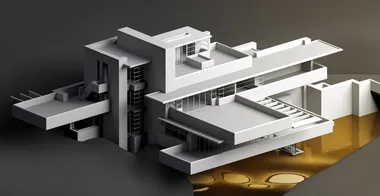
Fallingwater House
Model Frank Lloyd Wright's iconic Fallingwater house from construction documents to finished 3D geometry in Rhino. This 9-hour course covers the full exterior, from traced floor-plan lines and multi-story wall extrusions to cantilevered terraces, window mullions, staircases, and terrain.

Instructor Dusan Cvetkovic begins by importing scanned HABS drawings into Rhino, tracing the 2D edges, and setting up a layer system that keeps reference geometry locked while the 3D model builds up floor by floor. Because the original PDFs are not perfectly consistent between plans and sections, the course also teaches how to reconcile conflicting measurements, read section cuts for floor-to-floor heights, and make judgment calls based on reference photographs.
Beyond raw geometry, the course demonstrates how to use Blocks for repeating window frame assemblies so that updates propagate automatically, how to use the Volume Union and Boolean Split workflow to keep compound solids clean and ready for materials, and how to apply the Solid Points and Set Point tools for precise directional edits without disrupting surrounding faces. The project closes with organic rock sculpting and a terrain mesh for the surrounding landscape.
- How to import and scale multi-view architectural drawings (plans, elevations, sections) into Rhino and use them as locked reference layers
- How to trace 2D floor-plan geometry with clean joined curves and use Curve Boolean and Planar Surface to extract floor and wall outlines
- How to extrude walls floor by floor, measure heights from section cuts, and use Scale 1D for precise directional scaling
- How to use Solid Points On together with Set Point to move individual faces without breaking adjacent geometry
- How to build window mullion families as Blocks so that orientation copies update from a single source
- How to model staircases with Divide, Scale 1D, and Extrude Curve, then connect them to floor slabs using Boolean Difference
- How to apply Offset Surface and Boolean Split to add material thickness to glass panels, concrete slabs, and frame elements
- How to use Duplicate Edge and Duplicate Border as the basis for railing geometry and thin frame members
- How to sculpt organic rock forms by editing polygon control points, then build surrounding terrain as a deformable mesh