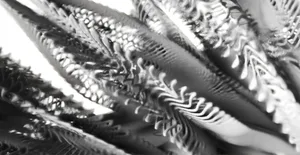
Complexity Through Repetition
In this two-day workshop, we'll explore how simple operations can evolve into complex geometry using the Anemone and Pufferfish plugins in Grasshopper. The focus will be on building a parametric system step-by-step using loops and repetition, starting with basic inputs and gradually creating more complex results.

In this two-day workshop, we'll explore how simple operations can evolve into complex geometry using the Anemone and Pufferfish plugins in Grasshopper. The focus will be on building a parametric system step-by-step using loops and repetition, starting with basic inputs and gradually creating more complex results.
We'll primarily work with the Anemone plugin that allows us to use recursions and loops in Grasshopper and the Pufferfish plugin (mainly the MeshMirrorCut component) to demonstrate how a small change in logic can lead to a big shift in form. Instead of focusing on a single practical outcome, this workshop focuses on the process. You'll learn how form and patterns can grow by repeating simple steps and changing small parts of the logic.
- Use the Anemone plugin to create recursive loops and repetition-based geometry in Grasshopper
- Apply the Pufferfish MeshMirrorCut component to generate complex self-similar forms from simple inputs
- Build parametric systems step-by-step, understanding how small logic changes create large shifts in form
- Work with mesh geometry, including splitting disjoint meshes and controlling edge lengths at micro scale
- Explore how mirror operations and recursive repetition create fractal-like complexity from basic shapes
- Set up V-Ray for Rhino with materials, lighting, and atmosphere settings for rendering complex geometry
- Control the balance between geometric detail and performance when working with recursion-heavy definitions
- Apply these techniques creatively to architectural and design projects as an architect, designer, or engineer
Session 1: Loops, Recursion, and Parametric Form Generation
- Installing and setting up the Anemone and Pufferfish plugins for Grasshopper
- Understanding recursion and loops: how the Anemone plugin enables repetition in Grasshopper
- Building a parametric system from basic inputs using iterative operations
- Using the Pufferfish MeshMirrorCut component to create complexity from simple geometry
- Exploring how switching mirror planes and changing logic creates diverse formal outcomes
- Working with mesh geometry, edge selection, and geometry manipulation techniques
Session 2: Advanced Complexity and V-Ray Rendering
- Iterating on recursive definitions to increase geometric detail at micro and macro scale
- Creating self-similar forms through repeated mirror modifiers and mesh operations
- Splitting disjoint meshes and controlling target edge lengths for detail refinement
- Introduction to V-Ray for Rhino: setting up the render environment and lighting
- Applying generic materials and adjusting atmosphere for architectural-quality renders
- Tips and tricks for bending light and creating compelling visualizations of complex geometry
Gediminas Kirdeikis
Gediminas Kirdeikis is a Senior Designer at Zaha Hadid Architects with extensive experience in computational design and urban architecture. Through his professional journey, he has contributed to significant projects including the 1.2 million square meter Unicorn Island Master Plan in China, where he specialized in facade model design and rationalization.
Gediminas runs two YouTube channels: Design Go Brr, where he focuses on design software educational videos, and a personal channel focused on architectural design. His approach combines creative exploration with technical rigor, helping designers understand how computational tools can expand their creative practice.