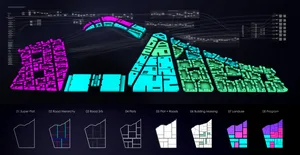
Computing Urbanism
Computing Urbanism highlights the application of computation and algorithmic tools in master planning and urban design. Participants will be introduced to parametric, algorithmic, and data-driven methods that enable designers to analyze complex urban systems, generate adaptive design solutions, and test scenarios with precision and speed.

In view of the current advancement of computational technologies, parametric modelling software such as Grasshopper has been strongly emerging to enable the user to record the history of the modelling procedures explicitly, which gives the designer advantages in automating multiple aspects of the 3D model and automatically updating any further adjustments.
Computing Urbanism is a workshop that highlights the application of computation and algorithmic tools in master planning and urban design. This workshop examines the transformative impact of computation on contemporary urban design. Participants will be introduced to parametric, algorithmic, and data-driven methods that enable designers to analyze complex urban systems, generate adaptive design solutions, and test scenarios with precision and speed.
- Apply computational and algorithmic tools to master planning and urban design workflows
- Use parametric modeling in Grasshopper for automated urban massing generation and iteration
- Analyze complex urban systems using data-driven methods and algorithmic design strategies
- Generate adaptive design solutions that respond to site constraints and performance criteria
- Test urban design scenarios with precision and speed using computational evaluation methods
- Create road network layouts and circulation patterns using algorithmic tools
- Develop parametric urban design definitions that can be rapidly adjusted and optimized
- Apply computational urban design methods learned from large-scale projects at leading firms
Session 1: Computational Urban Design Fundamentals
- Introduction to computational urbanism and its impact on contemporary urban design practice
- Setting up parametric urban massing generation workflows in Grasshopper
- Algorithmic methods for analyzing site constraints and urban context data
- Generating road network layouts and circulation patterns using computational tools
- Data-driven approaches to evaluating urban design scenarios and performance metrics
- Creating adaptive massing solutions that respond to multiple design criteria
Session 2: Advanced Urban Design Computation
- Advanced algorithmic techniques for complex urban system analysis and design generation
- Developing parametric definitions for rapid iteration of urban design alternatives
- Testing and comparing urban design scenarios using computational evaluation methods
- Integrating environmental and performance data into urban design optimization
- Scaling computational design methods from individual buildings to master plan level
- Practical applications from real-world large-scale projects at leading architectural firms
Omar Kaddourah
Omar Kaddourah is a Senior Designer at Zaha Hadid Architects with extensive experience in computational design and urban architecture. Through his professional journey, he has contributed to significant projects including the 1.2 million square meter Unicorn Island Master Plan in China, where he specialized in urban design and massing computation.
As a computational design expert at BIG (Bjarke Ingels Group), he was instrumental in developing a comprehensive algorithmic toolkit comprising over 30 tools for urban design applications. Omar shares his expertise through teaching and research, focusing on advanced computational methods for master planning, urban analysis, and data-driven design.