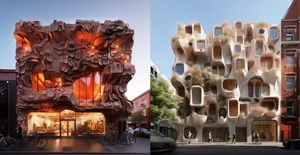
Creative Hallucination: Design Co-created with Predictive Pixels
During the workshop, we will explore the cutting-edge intersection of human creativity and artificial intelligence using AI tool called Midjourney. We'll dive into the nature of large language models (LLMs) and diffusion models, focusing on the concept of 'predictive pixels' in visual creation.

During the workshop, we will explore the cutting-edge intersection of human creativity and artificial intelligence using AI tool called Midjourney. We'll dive into the nature of large language models (LLMs) and diffusion models, focusing on the concept of 'predictive pixels' in visual creation.
You'll discover how the co-creation process between humans and machines shapes innovative design, where each informs and enhances the other's capabilities. We'll draw inspiration from the concept of 'controlled hallucination' in neuroscience, as explored by Anil Seth, to understand how these ideas propel AI development and open new frontiers in design. This workshop is a unique opportunity to understand and harness the potential of AI in architecture and creative fields.
- The fundamentals of large language models (LLMs) and diffusion models, and how they power visual AI tools like Midjourney
- The concept of "controlled hallucination" from neuroscience (Anil Seth) and its parallels in AI image generation
- How the co-creation process between humans and machines shapes innovative architectural design
- Setting up and navigating the Midjourney Discord interface for architectural projects
- Writing effective prompts for architecture: structuring keywords, styles, composition, and scene descriptions
- Using image references, blending, stylization, and remix mode to iterate on design concepts
- Generating photo-realistic architectural visualizations, aerial shots, and perspective views with AI
- Exploring speculative architecture: combining unexpected styles (e.g. traditional Chinese ink painting + parametric design)
- Practical exercises: creating AI-generated design explorations and visual narratives
- Integrating Midjourney outputs into your existing architectural workflow
Session 1: Introduction to Midjourney and Predictive Pixels
- Welcome and workshop overview
- Introduction to AI in architecture: from hand drawing to computer-generated to AI-generated
- Understanding Large Language Models and diffusion models
- The concept of "predictive pixels" and "controlled hallucination"
- Tour of Midjourney interface and Discord setup
- Writing your first architectural prompts
- Live demonstration: generating architectural visualizations
- Interactive exercise: creating your first AI design explorations
- Q&A session
Session 2: Advanced Techniques and Design Application
- Recap and review of Session 1 homework
- Advanced prompting techniques: remix mode, image references, blending
- Stylization and aesthetic control in Midjourney
- Creating speculative architecture projects
- Combining styles: traditional art forms meets parametric design
- Jam session: collaborative creation and sharing
- Portfolio integration: using AI outputs in professional work
- Final Q&A and next steps
Xinyi Wang
Xinyi Wang is a Sydney-based architect and artist who also serves as a tutor at the University of Sydney. With experience at internationally renowned firms including Junya Ishigami and Associates in Tokyo and MAD Architects in Beijing, Xinyi brings a unique global perspective to the intersection of architecture and emerging technologies.
Xinyi's work explores the boundaries between human creativity and artificial intelligence, combining his architectural background with a deep interest in generative AI tools. His design explorations push the limits of what is possible when architects collaborate with AI, creating speculative architectural visions that challenge conventional design thinking.
Through his teaching and creative practice, Xinyi has developed a hands-on approach to introducing architects to AI tools, making complex concepts accessible while maintaining the artistic integrity that defines great architectural design.