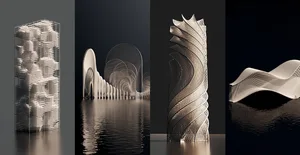
Decoding Design with Grasshopper
This workshop offers a practical and engaging introduction to Grasshopper 3D, a leading visual programming tool for architects and designers. Whether you're brand new to parametric design or looking to strengthen your foundation, this session will guide you through the essentials of using Grasshopper as a powerful creative and technical tool.

This workshop offers a practical and engaging introduction to Grasshopper 3D, a leading visual programming tool for architects and designers. Whether you're brand new to parametric design or looking to strengthen your foundation, this session will guide you through the essentials of using Grasshopper as a powerful creative and technical tool.
The workshop is structured into two main phases. First, you'll explore the core interface of Grasshopper, learning how to navigate, organize, and think logically within its visual scripting environment. Second, you'll dive into the geometry: learning to analyze, deconstruct, and rebuild design elements from a computational standpoint. Through a series of hands-on exercises, you'll learn how to translate architectural ideas into adaptable parametric models.
- Navigate the Grasshopper 3D interface with confidence, including canvas management, component search, and wire connections
- Understand parametric logic and visual scripting fundamentals for architectural design workflows
- Work with data trees, grafting, and flattening to manage complex geometry collections in Grasshopper
- Break down and rebuild architectural geometry using computational logic and deconstruction techniques
- Create parametric models from scratch through hands-on exercises with core Grasshopper components
- Install and use free Grasshopper plugins to expand the built-in capabilities of the software
- Apply parametric design principles to real architectural projects with adaptable, rule-based definitions
- Build confidence in translating design ideas into computational workflows that can be iterated and refined
Session 1: Grasshopper Interface, Logic, and Visual Scripting
- Overview of parametric design projects and real-world applications in architectural practice
- Navigating the Grasshopper 3D interface: canvas, components, wires, and organization
- Understanding parametric logic and how to think computationally about design problems
- Working with number sliders, boolean toggles, and basic data flow between components
- Introduction to free plugins that expand Grasshopper's built-in capabilities
- Building your first parametric definitions with step-by-step guided exercises
Session 2: Geometry Deconstruction and Parametric Modeling
- Understanding data trees: grafting, flattening, and managing geometry collections visually
- Analyzing and deconstructing existing geometry into parametric components
- Rebuilding architectural elements using computational logic and rule-based definitions
- Creating parametric surface patterns and subdivisions from simple inputs
- Hands-on exercises translating architectural ideas into adaptable Grasshopper scripts
- Techniques for iterating designs and managing complexity in larger definitions
Bryan Garcia
Based in Alicante, Spain, Bryan Garcia is a British architectural designer with a strong focus on parametric design. Over the past four years, he has developed a deep expertise in computational techniques, working extensively as a geometric specialist for architectural projects spanning diverse scales and disciplines.
Bryan's practice bridges preliminary design phases with advanced consultancy for multidisciplinary studios, bringing an innovative approach to parametric design that combines aesthetic exploration with geometric precision. With a social media following of over 77,000, he shares his work and promotes learning through open access, demonstrating the versatility of parametric design as both an architectural and graphic design tool.