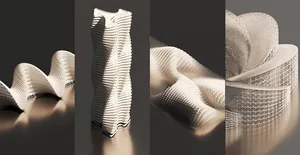
Decoding Design with Grasshopper vol.2
Design often begins with ideas that feel abstract, ambitious, or even overwhelming. This workshop is about learning how to take those complex concepts and make them tangible through the lens of geometric logic. By combining Rhino's modeling capabilities with Grasshopper's parametric power, we will explore practical ways to break down intricate forms and transform challenging ideas into clear, buildable designs.

Design often begins with ideas that feel abstract, ambitious, or even overwhelming. This workshop is about learning how to take those complex concepts and make them tangible through the lens of geometric logic. By combining Rhino's modeling capabilities with Grasshopper's parametric power, we will explore practical ways to break down intricate forms and transform challenging ideas into clear, buildable designs.
This workshop is aimed at participants with some prior knowledge of Grasshopper, but it is also accessible to those with less experience. The focus is on developing a way of thinking through design logic, with the technical teaching serving to support and formalize that process into scripts. The goal is to build confidence in approaching complexity, whether you are strengthening existing skills or discovering new ones.
- Break down complex architectural forms into understandable geometric steps using computational logic
- Use geometric principles to guide design decisions and reveal underlying structures in intricate forms
- Develop Grasshopper definitions that stay flexible, efficient, and adaptable to design changes
- Explore strategies for turning abstract design ideas into understandable, buildable geometries
- Structure parametric definitions that remain organized and efficient as complexity increases
- Move from abstract concepts to formalized geometry and building-ready design outputs
- Strengthen your design thinking through computational logic and hands-on scripting exercises
- Combine Rhino modeling with Grasshopper parametric power to tackle challenging architectural forms
Session 1: Geometric Logic and Form Decomposition
- Breaking down complex architectural forms into understandable geometric steps
- Using geometric principles and spatial logic to guide parametric design decisions
- Developing flexible Grasshopper definitions that adapt to changing design requirements
- Hands-on exercises in deconstructing intricate forms and revealing their underlying structure
- Strategies for organizing scripts to maintain clarity and efficiency at scale
- Transforming abstract design concepts into parametric models through logical workflows
Session 2: From Concept to Buildable Geometry
- Moving from abstract ideas to formalized geometry and building-ready concepts
- Advanced techniques for structuring definitions that remain efficient and adaptable
- Exploring the relationship between geometric precision and aesthetic exploration in design
- Practical exercises in creating complex forms through systematic computational logic
- Building confidence in approaching design complexity with parametric tools
- Review of key workflows and strategies for continuing your computational design journey
Bryan Garcia
Based in Alicante, Spain, Bryan Garcia is a British architectural designer with a strong focus on parametric design. Over the past four years, he has developed a deep expertise in computational techniques, working extensively as a geometric specialist for architectural projects spanning diverse scales and disciplines.
Bryan's practice bridges preliminary design phases with advanced consultancy for multidisciplinary studios, bringing an innovative approach to parametric design that combines aesthetic exploration with geometric precision. With a social media following of over 77,000, he shares his work and promotes learning through open access, demonstrating the versatility of parametric design as both an architectural and graphic design tool.