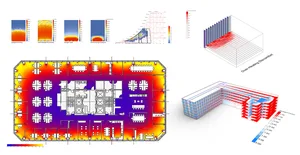
Design with Climate: Daylighting and Indoor Comfort using Honeybee Tools
A comprehensive introductory course designed to help participants understand the basics of building performance simulations in Honeybee Tools for Grasshopper3D. The course will demonstrate how performance-based design can guide decision-making to achieve sustainable and comfortable architecture.

The workshop will be a comprehensive introductory course designed to help participants understand the basics of building performance simulations in Honeybee Tools for Grasshopper3D. The course will demonstrate how performance-based design can guide decision-making to achieve sustainable and comfortable architecture.
Tailored for building engineers, architects, climate designers, and other professionals, this hands-on session equips participants with the skills to analyze natural daylight and indoor thermal comfort using EnergyPlus. You'll learn to set up an energy model, grasp the underlying theory, run simulations with standard metrics, and effectively visualize and interpret results. Upon completion, participants will have a solid foundation to apply these tools in real-world projects, enabling climate-responsive and data-informed design decisions.
- Introduce participants to the basics of energy modeling using Honeybee.
- Demonstrate how to set up and run multiple daylighting and thermal comfort simulations effectively using an energy model.
- Develop skills to interpret and communicate results for informed decision-making in sustainable and comfortable design.
Day 1: Building Performance Simulations, Energy Modeling & Daylighting Studies
- Introduction to Building Performance Simulations and Honeybee: Importance of performance analysis in sustainable design and architecture, Introduction to Honeybee toolbar
- Energy Model: Set up and Principles: Explanation of elements, structure and hierarchy for energy modeling in Honeybee
- Daylighting Studies: Compare the methodologies and understand each one's use (Lecture)
- Demonstration of multiple daylight analysis: Daylight Factor (DF), Spatial Daylight Autonomy (sDA), Useful Daylight Illuminance (UDI), Annual Sunlight Exposure (ASE)
- Cabin Model: Real-world example (Run DA analysis, Address and solve lighting issues)
- Urban High Rise: Real-world example (Simulate DF of multiple floors)
Day 2: Indoor Thermal Comfort Studies & Pollination Workflows
- Indoor Thermal Comfort Studies: Understand core principles of indoor comfort measurements (Metrics: PMV and PPD vs Adaptive Comfort)
- Analysis on direct impact of a massing on thermal quality in a simple single zone building, using each metric
- Demonstration of the expansion into more complex multi-zone building
- Pollination Workflows: Demonstration of pollination workflows and cloud computing
- Collaboration strategies for team-based projects
Ricardo Ruiter Kanamori
Ricardo Ruiter Kanamori is a BIM architect and computational designer with a Master of Science in Architecture from Delft University of Technology. Throughout his academic journey, he discovered his passion for environmental analysis and design efficiency in BIM. He has since continued to explore these areas in his work at Schmidt Hammer Lassen Architects and, currently, at Daiwa House Modular Europe.