Mastering Mesh-Driven Parametric Design with Nautilus
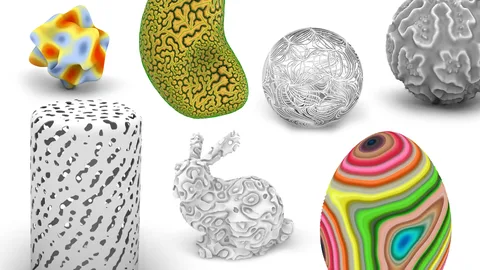
Join Laurent Delrieu for an in-depth introduction to the Nautilus plugin, a powerful community-inspired Grasshopper toolkit born from real-world problem-solving on the McNeel forums and tailored for advanced geometry and mesh processing. In this 2 days' workshop we will mainly explore scalar and vector field applied on meshes. We will make organic/generative design (reaction-diffusion patterns, noise fields, mazes) with practical fabrication needs.

Join Laurent Delrieu for an in-depth introduction to the Nautilus plugin, a powerful community-inspired Grasshopper toolkit born from real-world problem-solving on the McNeel forums and tailored for advanced geometry and mesh processing.
In this 2 days' workshop we will mainly explore scalar and vector field applied on meshes. We will make organic/generative design (reaction-diffusion patterns, noise fields, mazes) with practical fabrication needs. Attendees will gain insights into free vs. paid features, workflow tips. Basic Grasshopper skills are recommended.
A 30 days evaluation license for the Nautilus plugin will be provided to all attendees, allowing full access to explore the plugin's capabilities during and after the workshop.
- Scalar fields on meshes: noise generation, reaction-diffusion patterns, equations, and gradient tools.
- Vector fields on meshes: water flow simulation, noise-based fields, and edge-driven vectors.
- Mesh topology operations: mazes, shortest paths, and face ring analysis.
- Practical applications: lamp design with reaction diffusion, patterned Easter eggs, X-ray analysis, thickness analysis.
- Mesh divide tools: cluster mesh, unweld operations, and packing techniques.
- Working with the Nautilus plugin ecosystem: free components, test features, and paid tools.
Day 1: Scalar Fields, Noise, Reaction-Diffusion & Mesh Topology
- Introduction to Nautilus and mesh fundamentals: vertices, edges, faces, tessellation types (TriRemesh, QuadRemesh, Remesh By Color)
- Scalar fields on meshes: generating weight data on vertices using noise (Fast Noise Lite, Blender 3D noise), equations, and curve-based gradients
- Practical tools: iso-splitting meshes and curves, mesh bump, color visualization with gradients
- Reaction-diffusion patterns: creating organic textures on surfaces, building a lamp with directional control
- Mesh topology: face ring analysis, shortest path, maze generation on mesh surfaces
- Scalar field applications: thickness analysis, X-ray analysis, ambient occlusion
Day 2: Vector Fields, Flow Simulation, Packing & Advanced Techniques
- Vector fields on meshes: generating from scalar gradients, noise, and mesh edges
- Water flow simulation: using tangential vectors, handling flat zones with smoothed vectors
- Mesh divide tools: cluster mesh, unweld, and packing techniques
- Snow flake patterns: stepped bumps and hexagonal deformations driven by scalar data
- Color and UV tools: image-based gradients, custom color mapping on complex geometry
- Wordle generation on meshes, field-driven text placement, and fabrication-ready outputs
Laurent Delrieu
Laurent Delrieu is a French engineer and independent developer specializing in parametric design and digital fabrication. He graduated in 1995 from ENSIETA (now ISAE-ENSMA) in Brest, France, as a pyrotechnic engineer. After a career in that field, he transitioned to parametric modeling and computational design using Grasshopper for Rhino.
Today, as a self-employed professional, he leverages his expertise to assist companies in developing custom tools and workflows in Grasshopper. He is the creator of Nautilus, a popular Grasshopper plugin available on Food4Rhino. Nautilus bundles over 250 components (with ongoing updates) that he originally developed to support the Grasshopper community, including tools for advanced geometry, meshes, graphs, spirals, mazes, single-line paths for 3D printing and much more.
Laurent's own creative work focuses on designing and fabricating 3D objects from flat sheets, often through parametric techniques involving cutting, folding, and assembly. He shares his experiments, Nautilus developments, and parametric artwork on the McNeel Discourse forum, where he is an active contributor.