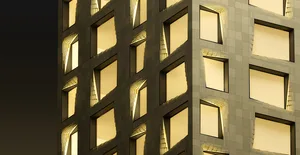
Parametric Stone Facade with Pixelated Openings
In this workshop, we will build a large Grasshopper definition step by step, growing it into a complex parametric system with more than 600 components. Inspired by the Softstone project by SETUParchitecture, the focus is on understanding the logic behind the setup and learning how to think parametrically.

In this workshop, we will build a large Grasshopper definition step by step, growing it into a complex parametric system with more than 600 components. Inspired by the Softstone project in Tehran by SETUParchitecture, used only as a conceptual reference, the focus is not on rushing to a final result, but on understanding the logic behind the setup and learning how to think parametrically as the script becomes more complex.
We will go through how to manage data, keep large definitions organized, use simple logic to control behavior, and set up clear geometric relationships, all in a way that mirrors how Grasshopper is actually used on real architectural projects. This workshop is best suited for people who already have some Grasshopper experience, but beginners are welcome too.
- Use Relative Item to control facade panel spacing and create precise geometric relationships
- Apply Split Mask with dynamic masks driven by the parametric model for pattern control
- Combine Split Mask and Replace Nulls to create repeating patterns with alternating facade modules
- Sort points using Polar coordinates and switch between design versions with Stream Filter
- Use Create Set and Member Index to identify the most overlapping points in complex patterns
- Work with UV Surface directions, convert trimmed to untrimmed surfaces, and unify UV directions
- Split surfaces using precisely positioned isocurves for controlled facade subdivision
- Optimize recursive definitions by improving Anemone performance using multiple data inputs
Session 1: Building the Parametric Foundation
- Setting up the initial Grasshopper definition and understanding the Softstone reference project
- Using Relative Item to control facade panel spacing and geometric relationships
- Working with Split Mask and dynamic masks for parametric pattern generation
- Combining Split Mask and Replace Nulls for alternating facade module patterns
- Sorting points with Polar coordinates and managing complex data structures
- Keeping large Grasshopper definitions organized as component count increases
Session 2: Advanced Techniques and Facade Completion
- Displaying and working with UV Surface directions for facade control
- Converting trimmed surfaces to untrimmed and unifying UV directions
- Splitting surfaces using precisely positioned isocurves for subdivision
- Using Stream Filter to switch between different design versions
- Using Create Set and Member Index for finding overlapping geometry
- Optimizing Anemone recursive definitions with multiple data inputs for performance
Lazar Djuric
Lazar Djuric is the co-founder of How to Rhino, an educational platform dedicated to teaching architects computational design skills. With deep expertise in Grasshopper and parametric design, he specializes in creating complex architectural definitions that mirror real-world project workflows.
Lazar brings extensive experience in building large-scale Grasshopper definitions for architectural facades, urban design, and parametric systems. His teaching approach focuses on making complex computational techniques accessible, helping designers understand the logic behind the setup rather than just the final result.