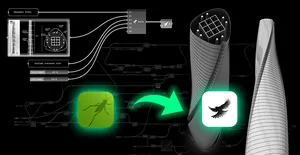
AI in Grasshopper with Raven Plugin
Raven is the Grasshopper native CAD AI system that generates, optimizes and debugs GH scripts. In this workshop, you will learn how to guide and instruct Raven for your parametric workflows through three key strategies: managing context and prompting, building reusable component libraries, and leveraging simulation feedback.

Raven is the Grasshopper native CAD AI system that generates, optimizes and debugs GH scripts. It is already used by over 3,000 professionals from the Rhino community to script, share and learn parametric workflows, and is compatible with 900+ public Grasshopper plugins and custom integrations. In this workshop, you will learn how to guide and instruct Raven for your parametric workflows.
We will work through three strategies to leverage Raven: managing context, prompting, and instruction following; building a reusable library of components that expand Raven for your unique needs; and leveraging simulations and computation-informed feedback to let Raven construct better-informed geometries. Join this workshop to dive deep into the best practices with Raven, the premier Grasshopper AI that supercharges your parametric workflows.
- Understand what Raven can and cannot do, and how to optimize the context of information you send
- Send images that work well to outline algorithms, including screenshots and error correction strategies
- Use existing Grasshopper scripts as context for Raven to build upon and extend
- Capture, encapsulate, and reuse scripts in clusters, snippets and as available functions for Raven
- Build a reusable component library that makes Raven more powerful as you use it
- Leverage native Grasshopper components and plugins for simulation-informed geometry generation
- Use real simulation feedback to let Raven construct geometries that actually perform well
- Apply best practices for prompting and instructing Raven across different parametric workflows
Session 1: Context, Prompting, and Instruction Following
- Introduction to Raven: what it can do, its capabilities, and its limitations within Grasshopper
- Managing context: sending images, screenshots, and existing scripts to guide Raven effectively
- Prompting strategies and error correction techniques for better AI-generated scripts
- Building reusable clusters, snippets, and functions that expand Raven for your workflows
- Creating a component library that makes Raven increasingly powerful over time
- Best practices for organizing and encapsulating scripts for long-term reuse
Session 2: Simulation Feedback and Advanced Workflows
- Leveraging native Grasshopper components and plugins beyond basic geometry generation
- Using real simulation feedback to guide Raven toward better-performing design solutions
- Combining geometry generation with computation-informed optimization strategies
- Practical examples of Raven-assisted parametric workflows on real design problems
- Integration with 900+ public Grasshopper plugins for expanded AI-assisted design
- Tips for continuing to develop your Raven workflow after the workshop
Moritz Rietschel
Moritz Rietschel is the co-founder of Romantic Technology and one of the primary creators behind Raven. His career operates at the cutting edge of architecture and computer science, with a specific focus on neuro-symbolic AI, bridging the gap between human creativity and machine logic.
Before launching Raven, Moritz contributed to advanced research at UC Berkeley's Robotic Fabrication Lab, where he developed systems designed to augment human ingenuity rather than automate it away. He founded Romantic Technology with the vision of creating tools that allow architects to explore complex design spaces without needing to be master coders.