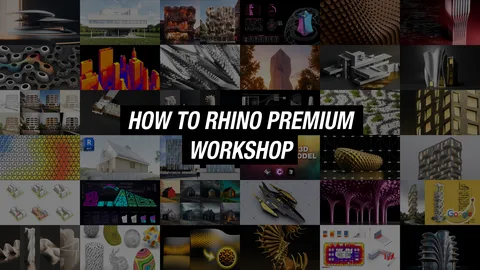
How to Rhino Premium Workshop
Our annual How to Rhino workshop, condensed into 5 days of live training that pulls together the best material from the Premium classroom. From Rhino modeling and Grasshopper to optimization, visualization, and the latest AI tools, you'll move from foundations to advanced computational design across the full week.


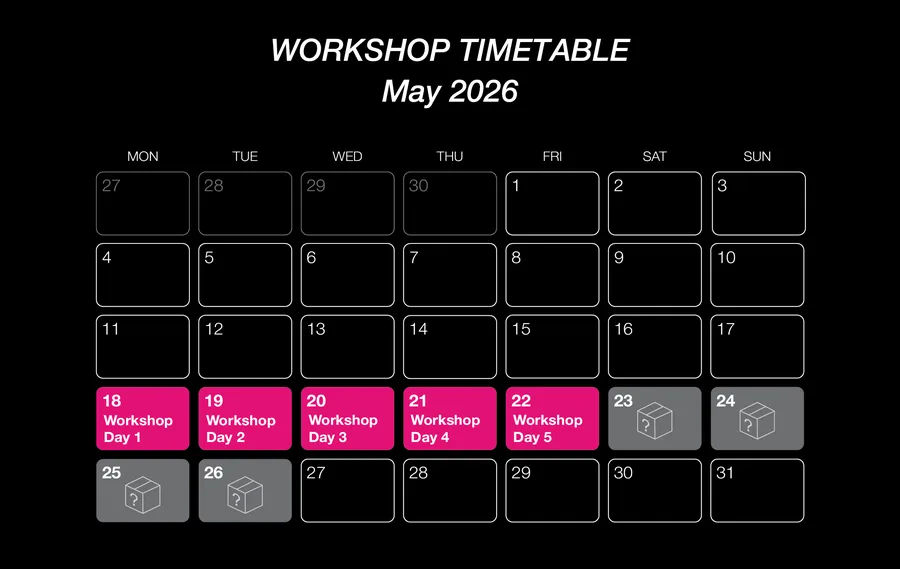
Once a year, we run a free annual How to Rhino workshop. This year it runs from May 18 to May 26, 2026, and it pulls together the best material we've taught inside the How to Rhino Premium classroom over the last two years.
From May 18 to May 22 we'll be live with you every day. Each day mixes live sessions with the best recorded material from our past workshops and mini courses, and runs around 5 to 6 hours. From May 23 to May 26 you'll have time to catch up on anything you missed. Every recording goes up the day after the session, so you can watch on your own schedule.
The first two days are great if you're just getting started with Rhino and Grasshopper. The last three days go deeper for intermediate users who want to push into optimization, rendering, and AI workflows. Whatever your level, you'll find something useful.
- Rhino 8 modeling foundations: interface, AutoCPlane, Blocks, push and pull workflows, section tools, and a deep SubD pass culminating in the London Aquatic Centre roof.
- Grasshopper from basics to real parametric facades, including data trees, the Schmidt Hammer Lassen facade, and custom panelization with Split Tree and Relative Item.
- Optimization in Grasshopper with Galapagos and genetic algorithms, ending with a daylight-tuned tower facade driven by Ladybug sun-hour analysis.
- Visualization across V-Ray, D5 Render, ComfyUI with Flux, and Nano Banana, from photoreal renders to AI-driven image generation.
- AI productivity tools (ChatGPT, NotebookLM, Claude, Comet) and custom AI apps with Claude Code and Codex coding tools.
- Advanced computational design with Raven for Grasshopper, Bryan Garcia's graph-driven design approach, and Nautilus for mesh-driven fabrication.
Day 1: Rhino Modeling
- Foundations of Rhino 8: interface, AutoCPlane, Blocks, push and pull, and section tools
- Deep SubD pass: topology, edge loops, creases, MultiPipe, and Reflect
- V-Ray and Make2D pass to produce architectural diagrams
Day 2: Grasshopper
- Grasshopper interface primer and how to actually learn the software
- Data trees: items, lists, branches, paths, and matching
- Live build: a zigzag facade and a curved canopy with a column array
- Schmidt Hammer Lassen panel facade with gradient shifts and conditional glass openings
- Custom panelization with Split Tree and Relative Item, no Lunchbox required
- Periodic surface triangulation thickened with Weaverbird Catmull-Clark
Day 3: Optimization in Grasshopper
- What optimization actually is: parametric thinking, fitness landscapes, when to use it and when not to
- Galapagos and genetic algorithms: genomes, generations, selection, recombination, mutation
- Smallest bounding box for freeform facade panels, minimizing volume versus edge length
- Attractor-driven opacity facade tuned to a target opacity percentage
- Cylindrical tower with a wavy NURBS facade and angle-grouped zigzag panels
- Ladybug sun-hour analysis with EPW data, balancing over-exposed and under-exposed cells
Day 4: Visualization
- V-Ray for Rhino: HDRI dome lighting, Chaos Cosmos materials, and box mapping that matches real-world units
- Scatter with exclusion zones, V-Ray Fur, and two-pass interior plus exterior composites on the Marcio Kogan Redux House
- D5 Render essentials: Rhino LiveSync, scene library, terrain sculpting, and vegetation scatter and brush tools
- ComfyUI with Flux: ControlNet for sketch-to-render, LoRAs for ArcViz style, inpainting, and reference image control
- Nano Banana (Gemini 2.5 Flash) for architecture: weather edits, element placement, texture swaps, and multi-view drawings
Day 5: AI and Advanced Computational Design
- Custom AI apps with Claude Code and Codex coding tools
- Decoding Design with Bryan Garcia: graph-driven wave pavilion and rotated-triangle stacked tower
- Nautilus deep dive: scalar and vector fields on meshes, reaction-diffusion, noise fields, mazes, and gradient flow
- Fabrication-ready outputs: single-line paths for 3D printing, plus flat-sheet cutting and folding from mesh patterns
Dusan Cvetkovic
Dusan is an architect from Serbia and the co-founder of How to Rhino, an educational platform dedicated to teaching architects computational design skills. With over 86,000 YouTube subscribers and a thriving Premium community, Dusan and Lazar have built one of the largest Rhino and Grasshopper learning communities in the world.
Lazar Djuric
Lazar is an architect from Serbia and the co-founder of How to Rhino. He brings deep Grasshopper expertise from years of international project work, including a long stretch in China where he developed advanced parametric workflows for architectural firms. Today he leads much of the Grasshopper teaching at How to Rhino.
Ognjen Graovac
Ognjen is an award-winning architect and computational designer, founder of Algorithmic Architecture, and developer of popular Grasshopper plugins used by thousands worldwide. He has contributed to large-scale international projects, most notably the Madison Square Garden Sphere in Las Vegas, where he developed Grasshopper algorithms that produced over 30,000 precise structural elements for the inner sphere with sub-millimeter accuracy.