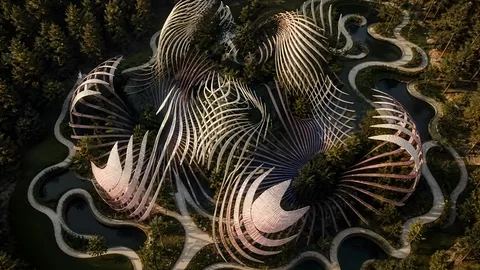
Synthetic Realities with Houdini, VEX Code and AI
Join Denisa Durica for a creative, hands-on workshop exploring how a single idea can grow into an entire cinematic synthetic universe. Through AI-assisted VEX coding, procedural geometry in Houdini, and a suite of generative AI tools, you will learn to transform an intuitive concept into a living visual world and develop it into a short cinematic film.

Creating synthetic realities begins with a simple inner impulse, a fragment, an emotion, an "egg" of an idea. In this workshop, participants will learn how to transform that first intuitive concept into a living visual universe through computational design, AI-assisted coding, parametric geometry, image generation, and animation.
The workshop connects artistic thinking with technical workflows. Participants will use ChatGPT/OpenAI to develop VEX code for Houdini, explore parametric control of geometry, and then transform raw structures into atmospheric worlds using AI tools such as LookX, Midjourney, Krea, Nano Banana, 8Frame, Caimera, Luma and Kling. The final outcome will be a short cinematic universe shaped by personal emotion, mood, and imagination.
- Develop a simple personal idea into a complete synthetic visual universe.
- Use AI as a creative partner for generating VEX code and computational structures.
- Build parametric geometry in Houdini through sliders, variation, rhythm, and distortion.
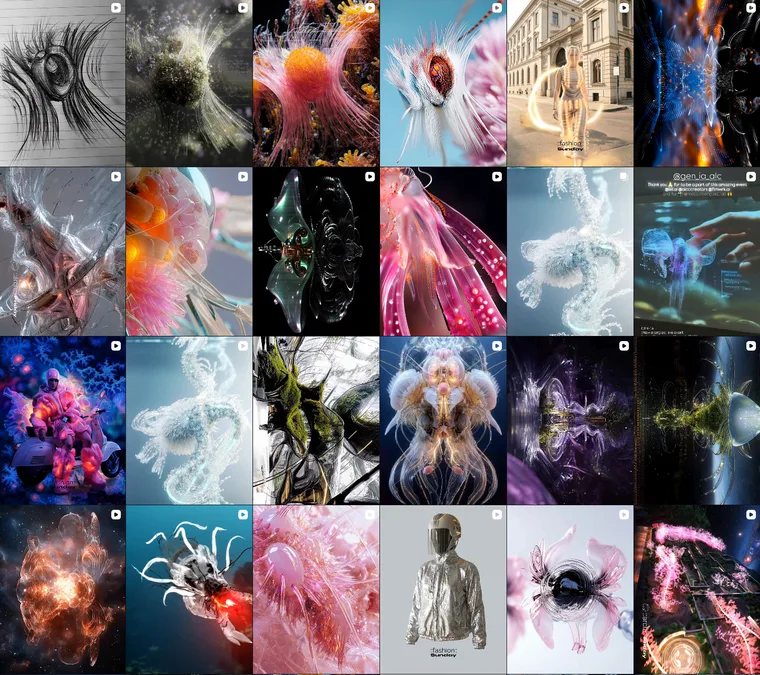
- Transform raw procedural forms into emotional visual outputs and cinematic images.
- Explore different moods, materials, colors, and atmospheres from one core geometry.
- Combine tools such as LookX, Midjourney, Krea, Nano Banana, OpenAI, 8Frame, Caimera, Luma and Kling.
- Move between organism, architecture, landscape, character, object, and dream environment.
- Create a personal visual language instead of relying on random AI generation.
- Animate synthetic realities and develop them into short visual narratives.
- Finish the workshop with a short movie of your own AI-driven universe.
Session 1: From Inner Idea to Computational Structure
- Introduction to synthetic realities and how personal ideas can become visual systems
- Defining the first concept: emotion, memory, object, organism, architecture, or atmosphere
- Translating an intuitive idea into simple geometric logic and procedural thinking
- Using ChatGPT/OpenAI to develop the first VEX code for Houdini geometry
- Building raw parametric structures in Houdini through curves, repetition, distortion, and rhythm
- Adjusting geometry with sliders to create variation, movement, density, holes, flow, and organic behavior
- Understanding how one coded structure can become many possible worlds
- Preparing black-and-white procedural outputs for further AI rendering and visual transformation
Session 2: From Geometry to Living Cinematic Universe
- Creating a personal palette of materials, colors, structures, atmosphere, and lighting for further work with black-and-white outputs
- Transforming Houdini outputs into atmospheric images using tools such as LookX, Midjourney, Krea, and Nano Banana
- Exploring different emotional directions from one geometry: soft, dark, alien, architectural, organic, cinematic
- Developing materials, light, color, texture, environment, and mood around the original structure
- Expanding the universe into characters, organisms, architecture, landscapes, objects, or hybrid spatial scenes
- Creating visual consistency across multiple outputs so the universe feels connected
- Preparing images and sequences for animation with tools such as Kling and 8Frame
- Building a short visual narrative from generated scenes, movements, and emotional transitions
- Finalizing a short movie of a personal synthetic reality created from code, AI, and imagination
Denisa Durica
Denisa Durica is an award-winning, internationally exhibited and published visual artist, senior architect, computational designer, and fashion innovator redefining contemporary creative practice through AI and generative systems. As a system-oriented creator, she transforms artificial intelligence from a rendering tool into a co-creative force, merging mathematical logic with intuition to construct immersive emotional realities.
Known as the Architect of Synthetic Realities, her multidisciplinary practice spans architecture, computational design, AI art, fashion, and immersive media, pioneering methodologies that shift boundaries between technological fields. With more than 20 years of architectural experience across international and local projects, she is increasingly active within the global exhibition scene through immersive films and AI-driven visual narratives.