
Walk into almost any leading architecture or engineering firm in 2026, and you will find a role that barely existed a decade ago, the computational designer. These are the people who build the parametric systems behind complex facades, automate the tedious parts of the design process, and connect architecture to data, fabrication, and increasingly to artificial intelligence.
It is also an in-demand specialization that an architect or designer can move into. On October 1, 2026, we found 14 open roles like this at firms such as Foster + Partners, BIG, Arup, and Grimshaw.
The good news is that you do not need a computer science degree or a decade of experience to get there. You need the right skills, a portfolio that proves that you can apply them, and a clear path to follow. This guide breaks down exactly what a computational designer does, the skills you need, what real job postings ask for, a step-by-step roadmap, what you can expect to earn, and where to find the jobs. At How to Rhino, this is the exact career path we have helped 901 students move toward through our courses and community.
Key Takeaways
- A computational designer uses code, parametric tools, and data to drive design, rather than drawing every outcome by hand. The role sits between architecture, programming, and fabrication.
- Grasshopper and Rhino are the core skills, usually paired with some scripting in Python or C# and a solid grasp of design and geometry fundamentals. All 14 postings we checked named both Grasshopper and Revit.
- You do not strictly need a specialized degree. A strong portfolio that demonstrates real parametric problem-solving matters more than credentials.
- AI is now part of the role. Half of the 14 postings we checked ask for AI tools or AI workflows.
- The fastest path is project-based learning. Build real definitions, document them, and assemble a focused portfolio rather than collecting tutorials.
What Is a Computational Designer?

Illustration generated with GPT Image 2.5
A computational designer uses logic, parameters, and code to generate and control design outcomes, instead of modeling every element manually. Where a traditional architect might draw a facade panel by panel, a computational designer builds a system that generates all the panels from a set of rules, and can regenerate them instantly when the design changes.
The role is fundamentally about building systems rather than drawing objects. You define relationships, such as how a roof responds to a structural grid, how a tower twists as it rises, or how an opening pattern adapts to sunlight on each facade. Change one input, and the whole design updates. This is the essence of parametric design, and it is what makes computational designers so valuable on complex projects.
In practice, the title overlaps with a few related ones, including computational design specialist, parametric designer, design technologist, and digital design specialist. The exact name varies by firm, but the core skill set is consistent. You are the person who can translate a design intent into a flexible, data-driven system.
Why Firms Are Hiring Computational Designers in 2026
Three forces have turned computational design from a niche interest into a sought-after profession.
First, buildings are getting more complex. Curved geometry, performance-driven facades, and ambitious structural forms are no longer reserved for a handful of starchitect projects. Clients expect them, and you cannot deliver them efficiently by hand. Firms need people who can build the systems that make complex designs buildable.
Second, efficiency pressure is relentless. Automating repetitive modeling, drawing production, and analysis saves firms enormous amounts of time and money. Arup, Grimshaw, Buro Happold, and GT-BIM all list workflow automation in their job ads.
Third, AI has accelerated everything. The rise of AI tools has not replaced computational designers. It has made them more powerful, because they are the people best positioned to integrate AI into real design workflows. BIG's posting for a Head of Design Technology calls fluency with AI essential. We cover this shift in depth in our guide to AI in architecture.
What Does a Computational Designer Actually Do?

Illustration generated with GPT Image 2.5
The day-to-day work varies by firm and project stage, but most computational designers spend their time on some mix of the following:
- Building parametric models for facades, structures, massing studies, and complex geometry that would be impractical to model manually.
- Automating repetitive tasks like drawing production, panel scheduling, data extraction, and model cleanup.
- Running design optimization, testing thousands of options against goals like daylight, structural efficiency, material use, or cost.
- Connecting design to fabrication, preparing geometry and data for CNC, robotic fabrication, or 3D printing.
- Building custom tools, writing scripts, or small plugins that solve a specific problem a firm runs into repeatedly.
- Bridging teams, acting as the link between designers, engineers, and fabricators who all need to work from the same model.
If that list sounds like a wide range, it is. The common thread is that you are always solving problems with systems and logic rather than brute force manual work.
Skills You Need to Become a Computational Designer
You do not need every skill below on day one, but this is the toolkit you are building toward.
Rhino and Grasshopper
This is the foundation. Rhino is the modeling environment, and Grasshopper, its visual programming plugin, is where most computational design actually happens. Grasshopper lets you build parametric definitions visually, without writing code, which is why it is the entry point for almost everyone in this field. Mastering Grasshopper, including data trees, lists, and the core component logic, is the single most important step you can take. Grasshopper 2 is now in beta inside the Rhino 9 beta, and our Grasshopper 2 comparison covers what changes. If you are choosing between visual programming platforms, our Grasshopper vs Dynamo comparison explains the differences.
Scripting With Python and C#
Visual programming will take you a long way, but the strongest computational designers can also drop into code when a problem calls for it. Python is the most approachable starting point and, since Rhino 8, runs inside Grasshopper as Python 3 in McNeel's new script editor, which replaces the older GHPython component. C# is common for performance-heavy tasks and for building proper Rhino plugins. You do not need to become a software engineer, but being able to read and write scripts dramatically expands what you can build.
Design and Geometry Fundamentals
Computational design is still design. A solid understanding of geometry, including curves, surfaces, vectors, and basic mathematics, is what separates someone who can follow a tutorial from someone who can solve a new problem. You do not need advanced mathematics, but comfort with geometric thinking is essential.
AI and Emerging Tools
In 2026, fluency with AI tools is quickly becoming a differentiator. AI assistants can generate and debug Grasshopper definitions, and AI-driven workflows are entering rendering, optimization, and analysis. McNeel's RhinoAI plugin now connects Rhino and Grasshopper to assistants such as Claude and Gemini, and we tested GPT-6 Astra modeling ten famous buildings in Rhino. Computational designers who can fold these tools into their process are more productive and more employable. Our AI in architecture guide is a good map of the current landscape.
What Real Job Postings Ask For in October 2026
On October 1, 2026, we opened job postings for computational designers, design technologists, and similar roles at named firms, and kept the 14 that were still open and asked for computational design or scripting skills. A skill counts if a posting names it as required, preferred, or a plus.
| Skill or tool | Postings that ask for it |
|---|---|
| Grasshopper | 14 of 14 |
| Revit | 14 of 14 |
| Rhino, including Rhino.Inside | 12 of 14 |
| BIM | 12 of 14 |
| Python | 11 of 14 |
| Dynamo | 11 of 14 |
| C# | 9 of 14 |
| Rhino.Inside | 8 of 14 |
| AI tools or AI workflows | 7 of 14 |
| JavaScript | 4 of 14 |
| Ladybug or Honeybee | 2 of 14 |
Example postings, checked October 2026 (some may since have closed):
- Design Systems Analyst at Foster + Partners, London
- Head of Design Technology at BIG, Copenhagen
- Junior Computational Designer at Arup, Milan
- Design Technologist at UNStudio, Hong Kong
- Design Technology Specialist at HOK, Houston
- Studio Design Technology Leader at Woods Bagot, Melbourne
A Step-by-Step Roadmap to Becoming a Computational Designer
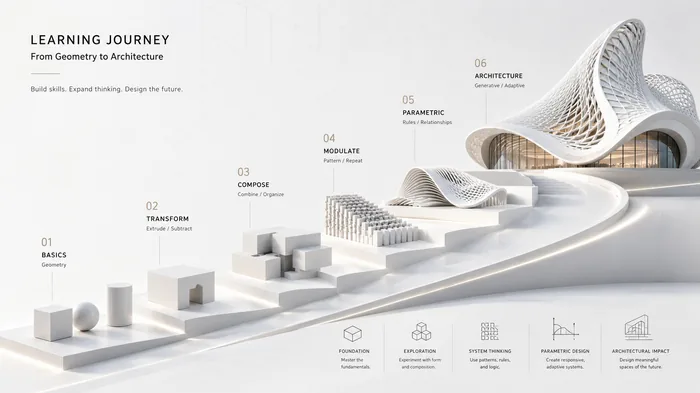
Illustration generated with GPT Image 2.5
Here is a realistic path from beginner to job-ready. The timeline depends on how much time you can commit, but most motivated people can become genuinely employable within six to twelve months.
- Step 1. Learn Rhino fundamentals. Get comfortable modeling in Rhino so that geometry is not the thing slowing you down later.
- Step 2. Master Grasshopper. This is the core. Work through structured learning until data trees, lists, and the main component families feel natural. This is where most of your time should go.
- Step 3. Build real projects. Recreate facades, structures, and patterns you admire. Building actual definitions teaches you far more than watching tutorials passively.
- Step 4. Add scripting. Once Grasshopper feels comfortable, start learning Python in the Python 3 script component to handle problems that visual programming makes awkward.
- Step 5. Learn optimization and analysis. Explore performance-driven design, daylight and structural analysis, and optimization workflows. This is where computational design delivers measurable value.
- Step 6. Integrate AI tools. Add AI assistants and AI-driven workflows to your toolkit to work faster and stand out.
- Step 7. Build a focused portfolio. Package your best three to five projects with clear documentation of the logic behind them.
If you want a structured way to start, our free training walks through how architects move from manual modeling into parametric and computational workflows, and where to focus first.
Do You Need a Degree to Become a Computational Designer?
This is one of the most common questions, and the honest answer is no, not necessarily. An architecture or engineering background helps, because computational design is grounded in real building problems. But firms hiring for this role care far more about what you can actually build than about a specific qualification. Still, 12 of the 14 postings we checked ask for a degree, usually in architecture or engineering, though none requires one in computational design.
Plenty of successful computational designers are largely self-taught, having learned Grasshopper and scripting through courses, practice, and real projects. Some come from architecture degrees, others from engineering, industrial design, or even outside fields entirely. What they share is a portfolio that proves capability. If you have a degree, lean on it. If you do not, your portfolio becomes even more important. Either way, the skill set is what gets you hired.
Building a Computational Design Portfolio
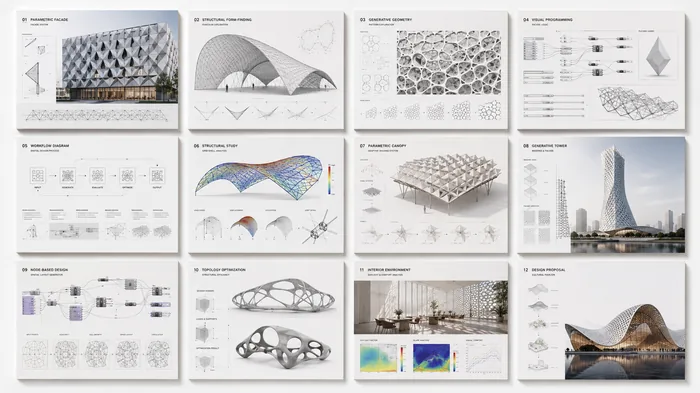
Illustration generated with GPT Image 2.5
Your portfolio is the single most important asset in this career. A degree opens a conversation, but a portfolio gets you the job. Here is what a strong computational design portfolio does.
- Shows the logic, not just the render. Hiring managers want to see how you think. Include diagrams of your definitions and explain the problem each project solves.
- Demonstrates range. A facade system, a structural study, an optimization project, and a custom tool together prove you can apply computational thinking across different problems.
- Prioritizes depth over volume. Three to five well-documented projects beat twenty shallow ones.
- Proves real problem-solving. Showing that you can take a messy real-world constraint and build a flexible system to handle it is exactly what firms are paying for.
For broader portfolio and application advice, our guide on building an architecture resume and portfolio covers presentation fundamentals that apply here as well.
Computational Designer Salary and Job Outlook
Exact figures vary widely by region, firm size, and experience, so treat any single number with caution. The most reliable numbers are the annual pay ranges that six of the 14 postings, all in the US, publish:
- Junior Computational Designer at Berenblum Busch Architects, Miami, $65,000 to $85,000
- BIM & Design Technology Specialist at Dattner Architects, New York, $70,000 to $95,000
- Graduate BIM & Computational Designer at Buro Happold, Los Angeles, $80,000 to $83,000
- Design Technology Specialist at Rockwell Group, New York, $80,000 to $100,000
- Computational Design Specialist at Grimshaw, Los Angeles, $95,000 to $115,000
- Computational Design & Automation Consultant at GT-BIM, Los Angeles, $100,000 to $130,000
For context, the US Bureau of Labor Statistics puts the median annual wage for architects at $99,280 in May 2025 and projects their employment to grow 4 percent from 2025 to 2035, about as fast as the average for all occupations. For a sense of how architectural salaries vary by location and role, our breakdown of architect salaries is a useful reference point.
Where to Find Computational Design Jobs
Computational design roles show up across a wider range of employers than many people expect:
- Large architecture firms with dedicated computational design or design technology teams.
- Engineering and facade consultancies that need parametric and optimization expertise.
- Fabrication and construction companies bridging design and manufacturing.
- Specialized computational design studios that work as consultants to other firms.
- Product and industrial design, where the same parametric thinking applies.
When searching, look beyond the exact title. Roles described as design technologist, parametric designer, facade specialist, or BIM and computation specialist often want the same skills. In our snapshot, the same toolkit sat under titles like design systems analyst and head of design technology. Most postings were on firm career pages, the rest on Archinect Jobs and Dezeen Jobs. Location matters too, since some cities have far denser concentrations of firms doing this work. Our guide to the best cities for architects is a helpful starting point for thinking about where the opportunities cluster.
Frequently Asked Questions
How long does it take to become a computational designer?
With consistent effort, most people can become genuinely employable within six to twelve months. The biggest variable is how much time you can commit to mastering Grasshopper and building real projects. Coming from an architecture or engineering background can shorten the timeline, since you already understand the design problems computational design solves.
Do I need to know how to code?
Not to start. Grasshopper is visual programming, so you can build sophisticated parametric systems without writing a single line of code. That said, 11 of the 14 postings we checked named Python, and learning some in Grasshopper's Python 3 script component significantly expands what you can do, and the strongest computational designers can script when a problem calls for it. Think of coding as a powerful upgrade rather than a prerequisite.
Is computational design a good career in 2026?
Yes, based on what firms are posting. The six US postings in our October 2026 snapshot that publish pay offer $65,000 to $130,000 a year, and half of all 14 ask for AI tools or AI workflows.
Will AI replace computational designers?
No. AI is making computational designers more productive. Because they understand both design logic and the tools, computational designers are the people best positioned to integrate AI into real workflows.
What is the difference between an architect and a computational designer?
An architect designs buildings across the full project lifecycle. A computational designer specializes in using parameters, logic, and code to generate and control design, often supporting project teams with complex geometry, automation, and optimization. Many computational designers are trained architects who chose to specialize in the technical, systems-driven side of the work.
Related Resources

Grasshopper Complete Course
Give your architectural skills a boost with the Grasshopper Complete Course. Get over 50 hours of comprehensive Grasshopper training tailored for architects. Learn to generate and iterate designs faster. Click below for more information and streamline your workflows!

![Architecture Internships: The Complete Guide [2026]](/images/blog/featured/variants/architecture-internships--related-card.webp?cb=seo-meta-20260227-164423)