For the last few years, AI has been very good at making pictures of buildings and very bad at modeling them. Ask a chatbot for a floor plan and you got something that looked plausible until you checked a single dimension. When OpenAI released GPT-6 Astra in early September 2026, the claim was different. This model was supposed to read drawings, understand 3D space, and build geometry you can actually use.
I did not want to test that on a box. So I gave it ten famous buildings, from Mies van der Rohe's Farnsworth House to Zaha Hadid's Heydar Aliyev Center, and let it research and model every one of them inside Rhino while I watched, timed the builds, and graded the results. This article is the honest summary of that experiment, including the prompts that worked and the building it could not handle.
Key Takeaways
- GPT-6 Astra can model real architecture in Rhino. It writes Python that runs inside your open Rhino session, so it uses the same commands you do.
- Orthogonal and rule-based buildings are largely solved. Farnsworth House took 23 minutes, furniture included, and stacked buildings like LEGO House came out recognizable and detailed.
- It can build real Grasshopper definitions. The Serpentine Pavilion 2016 came back as an editable parametric script with sliders, and it was the best result of the ten.
- Freeform is not there yet. The Heydar Aliyev Center was the one clear failure, even after a detailed correction round.
- The prompting matters more than the model. Research first, a visible build order, a quality-control pass and comparison screenshots made the biggest difference.
What GPT-6 Astra Is and Why Architects Should Care
GPT-6 Astra is OpenAI's model built for work in 3D space and computer applications. On BenchCAD, a benchmark that measures how accurately a model can reconstruct CAD geometry, Astra scored 95.9%, ahead of the 84.3% reported for Claude Fable 5.1 and the 83.3% of OpenAI's previous model, according to 3D Printing Industry. Access started with a limited group of organizations and then opened to ChatGPT Plus, Pro, Business and Enterprise users and the API.
The launch examples were impressive. People modeled whole houses in Blender and walked through them in Unreal Engine, and one user rebuilt a train from a single drawing with very high accuracy. I would still be careful with the 2D side. The AI-made floor plans I looked at had beds floating in the middle of rooms, furniture that did not touch the walls and grids that were not quite straight. They are good enough for spatial understanding, not for drawings. The 3D modeling is where this model is genuinely useful, and that is what I tested.
How GPT-6 Astra Models in Rhino
Astra does not move your mouse or click through menus. It works through the Codex app, writes Python, and runs that code in your open Rhino session through Rhino's scripting tools. Because the Python talks directly to Rhino, the model can use any command Rhino has, from simple extrusions to SubD modeling, blocks and Boolean operations. It can also write Grasshopper definitions, which turned out to be one of the most interesting parts of the test.
Setting it up takes a few minutes:
- Install the Codex app (available for Windows and Mac) and sign in with a ChatGPT subscription.
- Pick GPT-6 Astra in the model menu and set the reasoning level. I used Extra High for every building. There is an even higher "Think Ultra" level, but it drains your usage limits fast, and the 2x speed option also costs more usage.
- Add a local project folder. This is where the model stores the reference images, drawings and research it collects for each building.
- Open Rhino, keep it running, and tell the model that Rhino is ready.
I ran the whole test on the $200 ChatGPT plan, and on Extra High the usage meter is worth watching if you plan to model ten buildings in a row. I also used voice input for the longer prompts, which is much faster than typing out detailed instructions.
The Workflow I Used for Every Building
Every project followed the same three steps, and this structure is the main reason the results were as good as they were.
Step 1: Research before modeling
The first prompt never asked for geometry. It asked the model to collect everything it could find about the building and to wait for my approval. For Farnsworth House, the prompt was close to this:
Your goal is to 3D model this project in Rhino using Python. Before doing any modeling, check the project folder for files on this building, then go online and search for more drawings, images and dimensions, anything that helps you create a better and more detailed model. Tell me when you are done, and then we will do the modeling part.
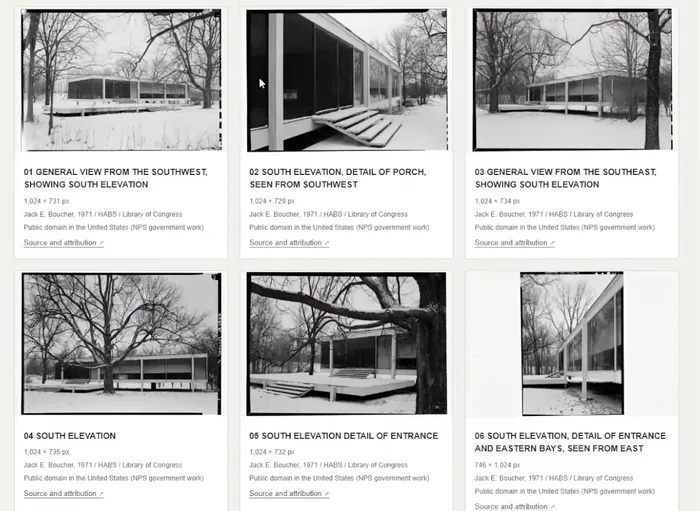
After about eleven minutes, Astra came back with eight measured drawing sheets, 28 additional photographs, a 55-page historic survey report and a list of checked dimensions, all organized in a folder with a visual HTML reference gallery. Later buildings got the same treatment. Olympic House came back with 78 images and diagrams, 15 PDFs and 31 dimension entries, and Shanghai Tower with 107 images, including facade connection and structural drawings.
Step 2: Give the green light and ask for a visible build
Once the research looked complete, I gave the go-ahead with one extra instruction that changed the whole experience. I asked it to build the model so I could watch it happen:
Keep in mind that we are recording a tutorial, so I want to see every step in Rhino. Put the elements in one by one instead of all at once. Do not add the roof until everything below it is finished, so we can see what is happening inside.
For multi-level buildings I added that it should grow the building level by level and finish each interior before adding the floor plate above. This is not only nicer to record. It also forces the model into a logical construction sequence, which makes mistakes easier to spot.
Step 3: Inspect, grade and correct
After each build I went through the model with shaded views and clipping planes, checked the interiors, and gave the building a grade out of ten. When something was clearly wrong, I sent the model screenshots and asked it to compare its work with the reference images before trying again.
Results for All 10 Buildings
| # | Building | Architect | Build time | Grade | What happened |
|---|---|---|---|---|---|
| 1 | Farnsworth House | Mies van der Rohe | 23 min | 7.5 | Complete house with foundations and furniture. The furniture was clumsy and no SubD was used. |
| 2 | Church of the Light | Tadao Ando | About 30 min | 8.3 | Concrete panels with tie holes, fillets, benches, a SubD Bible and the organ with its keys. Some overlapping geometry. |
| 3 | LEGO House | BIG | About 35 min | 8.5 | Built level by level with interiors, the tree and the dinosaurs. It caught and fixed its own mistake mid-build. |
| 4 | Villa Savoye | Le Corbusier | 30 to 40 min | 7 | Many self-checks after a quality-control prompt, but gaps remained and the ramp came out too steep. |
| 5 | National Assembly, Dhaka | Louis Kahn | About 45 min | 7.5 | Detailed exterior and a convincing auditorium. The file grew to 289 MB. |
| 6 | Niteroi Contemporary Art Museum | Oscar Niemeyer | Not recorded | 8.4 | The curved ramps worked far better than expected, with the water and the spiral stair included. |
| 7 | Serpentine Pavilion 2016 | BIG | Not recorded | 9.5 | Built as an editable Grasshopper definition. Two correction rounds with reference photos. The best result. |
| 8 | Olympic House | 3XN | About 45 min | 9 | Detailed facade, blocks, a solar roof with the Olympic rings and SubD trees. The stairs intersect. |
| 9 | Shanghai Tower | Gensler | Not recorded | 9 | Structure and facade only, as asked. 472 MB, split into checkpoint files and blocks. |
| 10 | Heydar Aliyev Center | Zaha Hadid Architects | Not recorded | 6 | Wrong wing orientation and a missing shell. Only partly fixed after detailed feedback. |
Farnsworth House in 23 minutes
The first building set the tone. Astra built the whole house in 23 minutes, from the foundations and the steel frame to the roof membrane, the kitchen, the bathrooms and the furniture, each on its own clearly named layer. The architecture was right. The furniture was not, because the chairs looked odd and a pipe stood in for something that should have been modeled with SubD. The kitchen was also built as separate overlapping pieces without any Boolean union. For a diagram or an early massing study, though, this is more than enough, and it is faster than I could model it by hand.
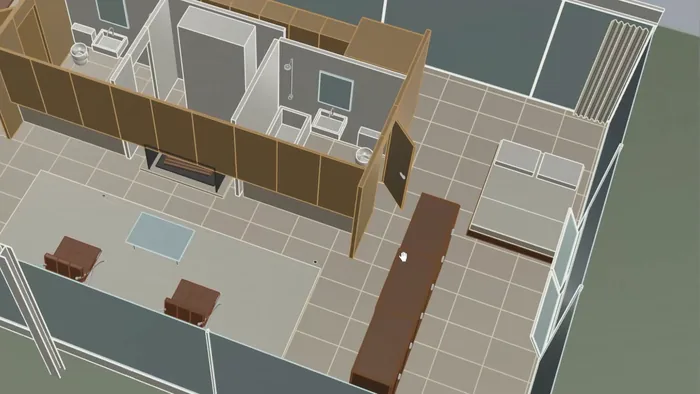
Farnsworth House with the roof hidden. The plan and core are right, the furniture is the weak spot.
LEGO House caught its own mistake
For LEGO House I asked the model to build level by level so we could see the building grow. While I was watching the progress, it noticed an error, went back and corrected it on its own, which was impressive to see. The final model has the colored terraces, the interior levels, the tree and even the dinosaurs. It was not perfect. One floor plate went missing where the model cut it to fit a wall and never put it back, and the file was heavy because much of the detail came in as meshes. Being able to read the drawings and understand what happens on each level is still remarkable.
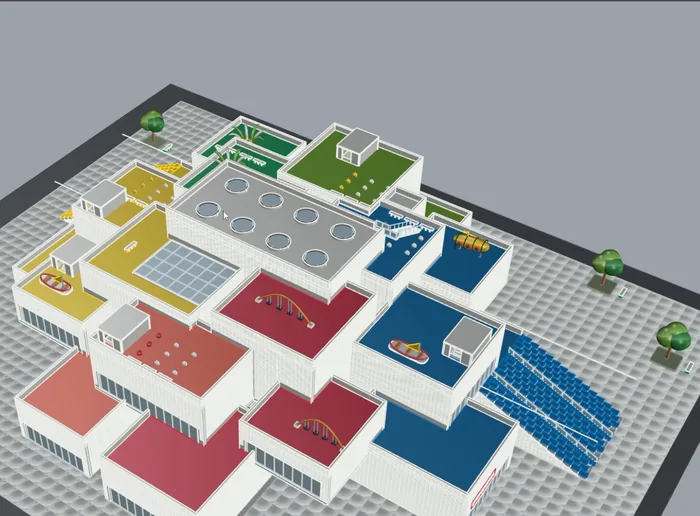
LEGO House, built level by level with interiors first and the roofs last.
The Serpentine Pavilion as a real Grasshopper definition
This is the result that surprised me most. Instead of modeling the pavilion directly, I asked the model to build it in Grasshopper and to make the script customizable, so the shape, the module sizes and the randomness could all be controlled. That is the whole point of parametric design with Grasshopper, and a plain Python component would have missed it.
The first version worked, but the boxes were twisted the wrong way. I pasted screenshots of the model next to reference photos and asked it to find the difference. The second version was closer. In the last round I pointed out that it had probably read an angle from a photo that was not an orthogonal top view. It went back, found a true top view, and fixed the geometry. The final definition has sliders for columns, rows, box sizes, depths and variation, with notes on the canvas explaining every step. I gave it a 9.5.
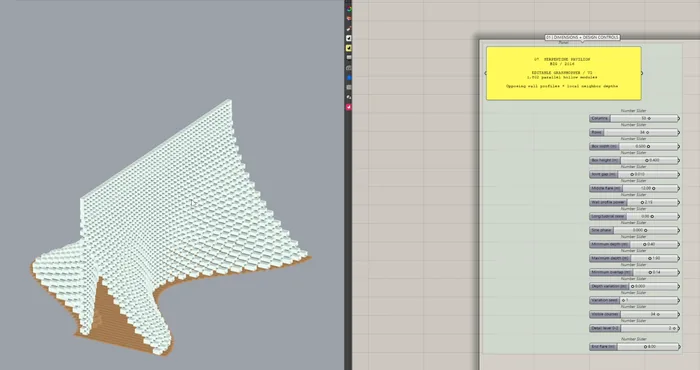
The corrected Serpentine Pavilion and the Grasshopper definition that drives it.
Olympic House and Shanghai Tower
The facade of Olympic House is the hard part of that project, so I told the model to rethink its approach, to use blocks for repeated elements, and to prefer Boolean difference over stacking geometry on top of geometry. It produced a detailed facade with properly connected construction elements, a solar roof with the Olympic rings and SubD trees in about 45 minutes. The stairs intersect each other and some facade joints are misaligned, but I am confident one or two more prompts would fix that.
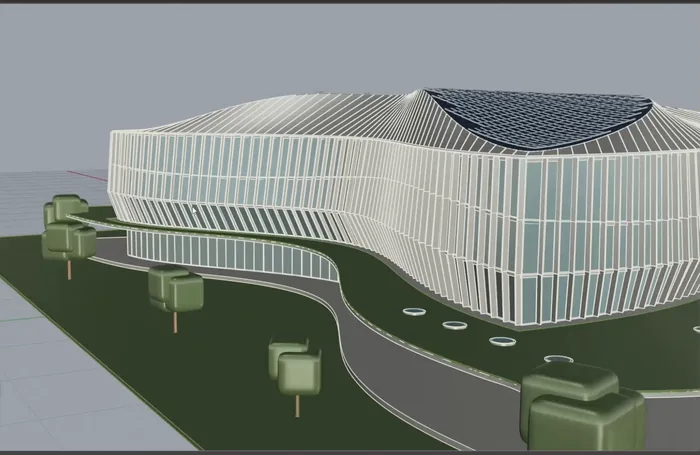
Olympic House. The facade was the focus of the prompt, and it shows.
For Shanghai Tower I asked for structure and facade only, with no furniture. The model followed that exactly, building the floor plates, the core, the steel and the double facade, and it split the tower into checkpoint files assembled as blocks. That was a smart move, because the full model reached 472 MB and Rhino struggled even to zoom.
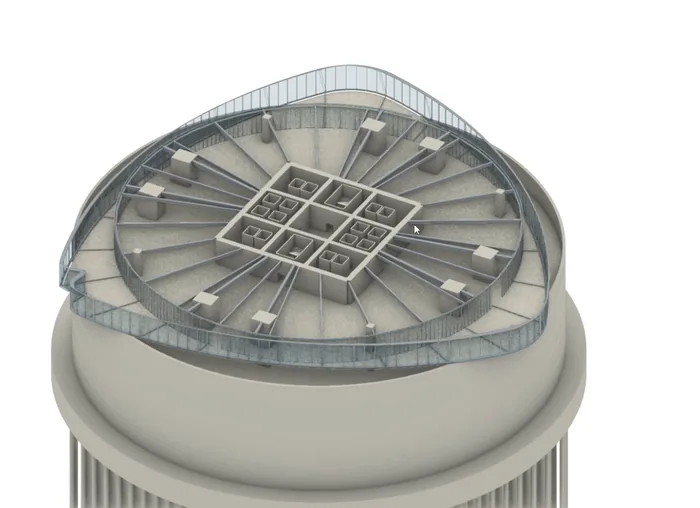
The crown of Shanghai Tower, with the core, the radial structure and the outer facade.
The Heydar Aliyev Center was the honest fail
I left the hardest building for last on purpose. The first attempt had some nice parts, but the main museum wing faced the wrong way, the shell that wraps the building was missing and the footprint was off. This time I was direct in my feedback. I told it that it had missed the whole point of the building, that it had not compared the elevations or checked the top view, and that it should analyze what went wrong before touching the model.
The analysis was genuinely good. Astra admitted that it got the main form wrong and that its checks did not justify calling the model finished, and it overlaid its own geometry on the published plan to show exactly where each mistake came from. The second attempt was still wrong. The shell flowed the wrong way, there were gaps, and the model only used lofts where I would have used SubD. If you want geometry like Zaha Hadid's, you still have to model it yourself.
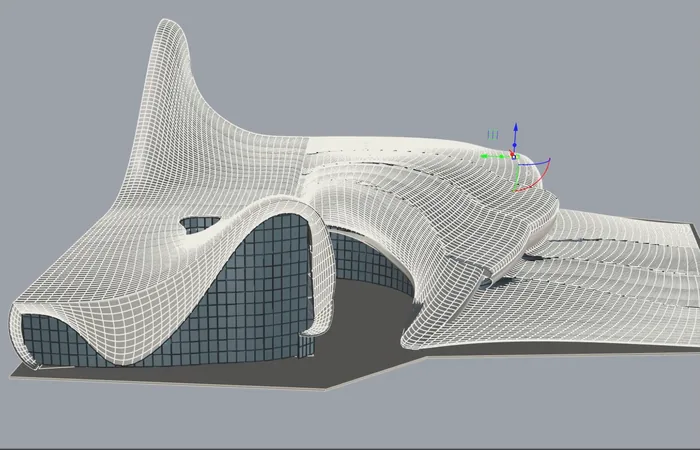
The second attempt at the Heydar Aliyev Center. Better, but still not the building.
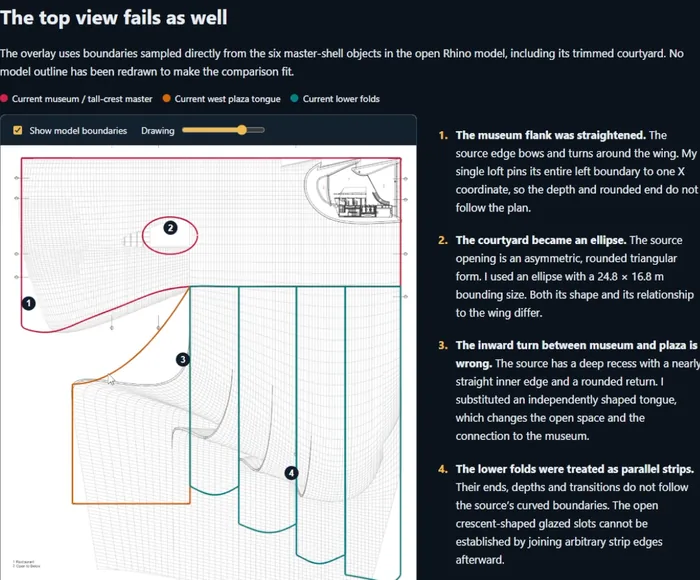
Astra's own diagnosis, overlaying its model on the published plan and listing what it got wrong.
What It Gets Right and Where It Breaks
After ten buildings, the pattern is clear.
Where GPT-6 Astra is strong:
- Orthogonal, stacked and rule-based architecture, from a glass pavilion to a stepped museum.
- Research. It finds drawings, sections, photos and dimensions quickly and organizes them into a clear visual report.
- Following a construction sequence and a layer structure when you ask for one.
- Grasshopper, when you ask for an editable definition instead of a static model.
- Curved but well-documented elements, like the Niteroi ramps, which I expected to fail.
Where it still breaks:
- Freeform shells like the Heydar Aliyev Center, where it falls back on lofts instead of SubD.
- Furniture and small objects, which tend to look clumsy.
- Intersections and gaps. The model is additive by nature, so it keeps adding material and rarely cuts it back.
- File size. The Dhaka model reached 289 MB and Shanghai Tower 472 MB, so ask for blocks and lighter geometry early.
- Knowing when it is done. It will call a model finished before it really is, so you have to check.
Prompting Lessons That Made the Biggest Difference
- Separate research from modeling. Ask for drawings, photos and dimensions first, ask for a visual report, and only then give the green light.
- Ask for a visible build order. Interiors before floor plates and roofs last makes the process easy to follow and the mistakes easy to catch.
- Add a quality-control step. On Villa Savoye I asked it to go inside the finished building and check for gaps, intersections and unfinished facades before reporting back. It made it slower but more careful.
- Correct it with images, not adjectives. Screenshots of your model next to reference photos, plus a true orthogonal top view, fixed the Serpentine Pavilion in two rounds.
- Tell it how to keep files light. Blocks for repeated elements, Boolean difference instead of overlapping solids, and no furniture when you only need the building.
- Name the tools you expect. After I mentioned SubD for organic parts, it used SubD for objects like the Bible in the Church of the Light and the trees at Olympic House.
- Be direct when it fails. A specific, even harsh, description of what is wrong produced a far better analysis than a polite "please fix this".
What This Means for Architects
I honestly did not expect this to be possible in 2026. This is the first time a model can produce useful 3D geometry and understand architectural space well enough to rebuild a real building from its drawings. It does not replace 3D modeling. You still model to explore ideas, test spaces and develop a design. But when the drawings exist and you need a detailed model of something already designed, a model like this can take over a large part of the execution, and we can spend more of our time on the creative side of the project.
It also changes what is worth learning. Every result in this test needed someone who knew Rhino well enough to spot the gaps, the intersections and the wrong wing, and to explain the fix. The architects who will get the most out of AI are the ones who understand the geometry it produces. If you want that foundation, our Rhino for Architects Course covers modeling, drawings and presentation from the ground up.
If you want to see the full experiment, the complete recording is available as a mini course in How to Rhino Premium. Automating 3D Modeling with GPT 6 Astra in Rhino runs about 2 hours 15 minutes and shows every prompt, every build, every correction round and the grade for each building, with the Rhino files and research packs included.
Frequently Asked Questions
Can GPT-6 Astra really model buildings in Rhino?
Yes. It writes Python that runs inside your open Rhino session and builds the geometry element by element. In our test it produced usable models of nine out of ten famous buildings. Orthogonal and rule-based architecture worked best, while freeform buildings like the Heydar Aliyev Center still failed.
Do I need a plugin to connect GPT-6 Astra to Rhino?
We did not use one. The Codex app wrote the Python and executed it in Rhino directly, with no mouse automation. You need the Codex app, a ChatGPT subscription with access to GPT-6 Astra, and Rhino running on the same computer.
How long does it take to model a building?
The research step for Farnsworth House took about 11 minutes, and the builds took between 23 minutes for Farnsworth House and about 45 minutes for the National Assembly in Dhaka and Olympic House. Correction rounds add more time for complex buildings.
Can GPT-6 Astra build Grasshopper definitions?
Yes, and it was the best result of the test. When asked for a customizable definition, it built the Serpentine Pavilion 2016 with sliders for the module count, sizes, depths and variation, and corrected the geometry after two rounds of feedback with reference images.
Will AI replace 3D modeling for architects?
Not for design work. Modeling is still how you explore and test ideas. AI is becoming very good at the execution part, rebuilding a design from existing drawings, which means architects who understand Rhino well enough to direct and check the AI will be far more productive than those who do not.
Related Resources
Rhino for Architects Course
Give your architectural skillset a major boost with the Rhino for Architects Course. Get over 60 hours of focused training tailored specifically for architects. Master commands and techniques to model, render, and animate architectural visualizations at the highest level. Click below for more information and watch your designs come alive!